• goodbadi

    Development in Process

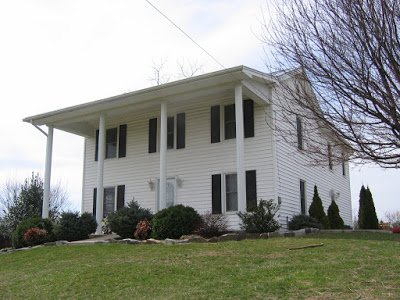
    A friend asked yesterday, “So is the house you bought a fixer-upper?”

    “It’s livable,” I said, “but there is a lot to improve.”

    “That’s the worst kind of place,” he said. “You never know if you want actually to tear into what needs done next.”

    As we’ve brainstormed and brainstormed–we think we have a pleasing floor plan, now–we’ve had to acknowledge time and again that our new house won’t be finished or how we really want it to be for quite some time. We have to move in and live in–and enjoy–its current state, and then chip away at realizing our hopes for it.

    It’ll be a process.

  • goodbadi

    De-“Solely Spiritual”-izing David

    I accept whatever agnostic tendencies I find in myself by noting that Jesus’ challenging words in Matthew 25:44-46 essentially and simply equate service to, relationship with, and redemption through him to the grit and grime of everyday, person-to-person reality.

    (Actually, I’m not sure if I think of myself as having agnostic tendencies. As The Freakwenter writes, “To explain why I’m neither a believer nor an athiest nor an agnostic, consider this: God sits far beyond the power of verbal description. Then, regardless of whether God exists, God also sits far beyond the power of verbal denial, and also beyond the even-handed verbal analysis of agnosticism.”)

    While some people see “personal relationship with Christ” as being the focal point of Christianity, with all other relationships and actions crowded under that one umbrella, I suspect that, whether or not there is a heavenly, spiritual arena, it is my immediately tangible world that embodies what really matters and cries out for what little I can do and be.

    In Sunday school on a recent Sunday–we were visiting a class about marriage; the day’s topic was how to handle your spouse’s past mistakes–we read the story of David and Bathsheba and then discussed in small groups the resulting Psalm 51 in which David writes in verse 4, “Against you, you only, have I sinned and done what is evil in your sight.”

    “I think David is in denial,” I said. We were supposed to be talking about David’s handling of his past mistakes, but we’d only come up with things like “He’s remorseful” and “He wants to be pure.”

    “In denial?”

    “Yes. David did not, as he says here, sin against God only. What about Bathsheba, Uriah, his people, his nation. What about them?”

    “Oh, but he’s speaking in hyperbole or something,” one lady said so quickly that I hadn’t even inhaled yet after my daring attempt at creative scriptural interpretation. “He can’t be in denial. Those people are included in his use of ‘God.'”

    Due to the intense rejection of what I thought was a remotely plausible idea, I didn’t add that the Psalm also suggests that David took less than complete responsibility for his actions–it was his mother’s fault, after all: “Surely I was sinful at birth, sinful from the time my mother conceived me”–and that he appears to have been seeking the easiest way out, by calling down divine intervention:Cleanse me with hyssop, and I will be clean; wash me, and I will be whiter than snow.”

    Now, I can accept that exclusively God-based forgiveness is sometimes the only conceivable enabler of fresh starts. And maybe that sort of forgiveness is what David really did need, here, since Uriah was already dead and since David by then couldn’t really undo anything regarding Bathsheba. There are times of desperation.

    But while my “creative” interpretation of Psalm 51 may be a little too, shall we say, creative, I still suspect that when all that “convicted” people seek are fix-and-forget-it cure-alls, we may find ourselves shirking our own essential, painful steps towards righting past wrongs and restoring joy, person to person.

  • goodbadi

    Biology Lesson

    After reading my sister’s birthday tribute to our dad, I thought I’d chip in my own version of the four-wheeler invasion story as included in a piece I wrote back in 2001:

    Biology Lesson

    The day Mom hung up the phone and told me, “Daddy’s bringing home a surprise for you today,” was one long day. I tried to read the Hardy Boys, I tried to work on the bow and arrow I was making, I tried to build an addition to the clubhouse in the back yard, but all I could think about was the surprise.

    I was nine. Ever since we’d moved out of town I’d desperately wanted a three-wheeler, a red one, a Honda 250, to ride out our driveway to the mailbox, to make trails in the woods, to go mud bogging, to drive over to Lynn T’s house and ask if she wanted to go for a ride. I dreamed for one, countless times. Someone gave us a pedal tractor and I promptly took the extra parts off of it so it looked like a rugged off-road vehicle. I bent my little brother’s tricycle’s handlebars practicing stunt maneuvers I knew I would someday do for real, on a real three-wheeler. My bicycle was usually covered with mud and was cleaned only on the warm afternoons when I decided to try to pedal through the swimming hole over by Jimmy D’s house.

    My friend Jason had a three-wheeler, one just like the kind I wanted to get. I’d gotten to ride it once, when his dad was home to watch us. I’d opened up the throttle the whole way, leaning into the back-road curves, shifting gears as though my luck was running out. It was, actually; it turned out, Jason’s dad made him ride with me.

    You went too fast,” Jason told me.

    Dad didn’t like off-road vehicles, including three-wheelers. He was a high school science teacher, a Mennonite hippie, someone who later built a composting toilet in our back porch and whose garden flourished in spite of the starved West Virginia soil. For him, hunting was an excuse to spend days on end in the woods. He didn’t like that his school was too far away to ride bike to every day. When he was a boy, his hobbies were raising pigeons and bird watching.

    One June day, during lunch, we heard a noise, the loud rasping of engines whining and sputtering. I dropped my fork and ran out of the house, my bare feet barely feeling the dirt path leading to the swimming hole. My brother was right behind me, and we didn’t stop until we’d reached the spot where I’d once snagged a 10-inch rainbow trout.

    My heart sped. “Look at that!” I yelled to my brother. “Awesome!” Four-wheelers, three-wheelers, motor bikes—they all drove full force into the swimming hole. One four-wheeler had stalled; its driver was working on the battery connection. An older man sat on his yellow three-wheeler, watching. Another three-wheeler, its wheels churning, floated past where we were standing. The roar was deafening; my brother and I stared.

    But Dad hadn’t been far behind my brother and me. With the force of all those spinning wheels he ran into the water, hitting it with all his might.

    “Damn machines! Get the hell out of here! You’re ruining this place!” He picked up a two-liter Pepsi bottle from the oiled water and tossed it to the side of the creek. “Get out of here!” I’d never heard my dad swear before. The engines coughed unapologetically and kept on. Dad walked out of the water to where Jimmy D was watching.

    You want me to get out my shotgun?” Jimmy asked. Dad shook his head. The old man on the yellow three-wheeler turned to leave, and the thrilling and damned machines drove off in a cloud of racket.

    My prospects of getting my own three-wheeler weren’t so good, I knew, but I hoped for one anyway.

    After I had put down the Hardy Boys, and had given up on working on the bow and arrow and the clubhouse, I shuffled to where my brother sat, playing in the sandbox.

    “Here, I’ll pull you in the wagon,” I said. We tore off through the woods, his little hands holding on for dear life as I flew over little ditches, skidded into puddles, and bumped over downed tree branches. My thoughts pounded, I might be getting a three-wheeler! I could just see Dad driving our old Ford Granada down our driveway with a trailer holding a brand new, red Honda.

    When our cow Ellen started bawling I knew Dad must be turning off the road, and my brother and I raced back to the house. I looked for a trailer. There was none. I looked for a truck—maybe someone else would be bringing the three-wheeler; of course, we didn’t have a hitch on our car. Dad got out of the car, his backpack in one hand and a glass jar of formaldehyde with a pig fetus inside in the other.

    That night we dissected the pig; it was one of my first biology lessons.
  • goodbadi

    Rich Uncle

    After M and I–joined for part of the time by my brother Z–sang our portion of the coffee shop gig we shared with another duo, we sat around listening to our friends sing as I drank my complimentary cappuccino that tasted like regular old coffee.

    My nephew J and niece R, two of the best front-row audience members in these parts, had watched us sing from two armchairs we’d scooted off the stage, and had even given us a note during the performance to request a song (which we sang but only with much stumbling about, since I couldn’t remember how to play the guitar part).

    As we sat around the table, J recycled the note paper, this time addressing it to Z: “Dear rich uncle. I am hungry. J.”

    I should note that my sister and her husband have been on a spending freeze in recent weeks, and intent on not spending any money on anything unnecessary, and so the kids knew full well the futility of begging them for any of the delightful treats on display in the coffee shop.

    So what could my brother do? He handed J his credit card, and he and R headed off to buy two chocolate chip scones, one for them and one for the rest of us to share.

    The communal delight was overshadowed only by my sister’s elevated sense of glee when finally, a bit later, her husband broke their spending freeze and bought a strawberry smoothie to share with the kids.

    “Now I can buy the cream cheese to use in this recipe,” she said as she finished copying it by hand from one of the shop’s magazines. “And go clothes shopping!”

    “I can’t go into a place and not buy something,” my brother-in-law said. “It doesn’t seem right.”

    And it’s not nearly so tasty, either.

  • goodbadi

    Sunday Afternoon Nap

    They used to be weekly events, but since N’s birth, Sunday afternoon naps have become quite rare. This afternoon, however, with N deep in her own slumber, I once again took to our living room futon for some much-needed satisfaction–until the upstairs people decided to vacuum their kitchen floor:

    Believe me: Our new house and the end of April are sounding better all the time.

  • goodbadi

    Time Change

    So explain this, please.

    Over the last few weeks, N has been going to bed right around 8:00. I can walk her to her crib, give her frog to her and say a few nice nighttime things, and she practically dives for slumber with (on most nights) nary a whimper.

    With daylight time approaching, however, I expected that she would begin going to bed around 9:00. But since the change–if you haven’t noticed yet, most of us sprang forward an hour on Saturday night–a strange phenomenon has taken place: Now N goes down to sleep around 7:50, following the same frog-nice-dive routine.

    By the clock. The new time.

    Amazing.

    (Hmmm. What else could we be getting away with?)

  • goodbadi

    Musical Sacrilege?

    Soon after M and I released our 2005 album, our half-hearted attempts at marketing our music took us to a small bulk foods store in a nearby small town.

    Yes, they would sell the CD for us, they said, but they wouldn’t play it over their sound system in the store because they only play “Christian” music.

    Our music, not Christian? Was that even possible, since we had always been dyed-in-the-wool Christians ourselves?

    Admittedly, none of the songs we’d recorded were of the “three chords for the Lord” flock, but they were all about life–which I’d say made them pretty much at least relevant to Christianity despite their lack of religious sentimentality.

    And besides, don’t Christian people so often deal with the exact same issues as non-Christian people? Things like greed, arrogance, and, well, shameless self promotion? No, there is nothing special about life that prohibits it from finding itself sung about under both “Christian” and “non-Christian” labels.

    Certainly one might argue that Christian musical treatment of common life might reflect a higher passion or even inject that flair into its listeners while secular music can only lead us to looking at ourselves through dimly blurred mirrors, but in reality the religious value of a song is most often only specked somewhere in the beautiful eyes of the beholders.

    For example, some people think that fiddle tunes and even classical movements aren’t “Christian.” I know others who insist that rock music instrumentation in itself is evil, in part because it, regardless of lyrical content, speeds listeners’ heart beats per minute and makes them do crazy things. Just look at the people jumping up and down when Petra sings Dance–and Petra is even one of the all-time historical Christian rock bands. Just think about how excited you get when Tommy Emmanuel plays Classical Gas and beats his microphone with his head.

    Occasionally songs from distinctively secular markets find themselves assigned Christian depth. Not too long ago we found ourselves visiting a church where the preacher recited excerpts from Neil Diamond’s Brother Love’s Traveling Salvation Show as an example of “finding a connection with others and with God.”

    “But that song,” my mother hissed to me, “is making fun of religion!”

    “It could be,” I said. “I think it is, too, but you wouldn’t have to think that. It’s a great song.”

    (We mustn’t forget that Dolly Parton sings that song, too, about Brother Love, which brings it to a whole new level of sacrilege or worship, depending.)

    Then there’s that really funny, karaoke-friendly Eight-Hundred-Pound Jesus by Sawyer Brown, which I can’t ever be too sure isn’t tongue in cheek, and Josh Turner’s Me and God, perhaps the most blasphemous song I’ve ever heard but which I suspect many religious types love. Are these songs sacred or sacrilegious?

    Sacred, secular, or otherwise, one song that in my book tops many is Paul Simon’s spiritually insightful and religious trappings-less Outrageous, which has become, as I’ve listened to it over the years, ever more meaningful for no reason in particular but partly because after hearing “Who’s going to love you when your lips are gone” I checked the album lyrics to find what Simon really sings.

    Enjoy.

  • goodbadi

    Weekend in Perspective

    This weekend my whole immediate family and Aunt P descended on my parents’ home to see my mom sing in a rather impressive community production of The Wizard of Oz. (I wanted to take video of her on stage dancing, but before the show there was a stern warning against such copyright violations.)

  • goodbadi

    21 Degrees

    I rode bike to school this morning even though the temperature, which was slated to rise to nearly sixty by the afternoon, hadn’t yet met my minimum requirement of twenty-five degrees.

    It was definitely cold, out there at twenty-one degrees. My fingers and toes required constant wiggling; my goatee touted ice crystals; only once did I panic–there was nothing else to do–when I found myself crossing ice spots.

    This afternoon, then, I found myself in balmy fifty-eight-degree sunshine–but buffeted head-on by the very winds that chased out the cold, I reckon.

    I definitely felt not too bad about having eaten the Pop-Tarts left over from yesterday’s pre-writing-test sugar injection into my school’s student body–even though I heard on an NPR health program last weekend that “Pop-Tarts are not a breakfast food.”