Anniversary 6
It’s our sixth wedding anniversary, and I have a bellyache.
I’ve had it since Friday, when I laid on my parents’ couch for almost the whole day, ate only toast and crackers and drank ice water and Ginger Ale until evening, when the pesto linguine and buttered and sugared squash followed by tapioca pudding with crushed strawberry sauce called my olfactory sense back from its figurative deathbed.
I’d had enough of the couch by then, and more than enough of reading Gone with the Wind, especially its descriptions of the neverending days of Atlanta’s Civil War seige and its accompanying physical discomforts, which were all the more vividly played out in my imagination due to my pitiful condition.
The squash and linguine were more healthy and tasty than any food we would have had had I not fallen ill, since if I’d been well we would have gone ahead with the date I’d planned in celebration of our six years of weddedness. Unbeknownst to M, we were going to go to a local restaurant (“If you can look past the dirt, it’s great,” one of my dad’s coworkers said of the place) to eat and watch the DVD of our wedding on a laptop. But I was in no way suited to that possibility, and we had to postpone the festivity.
Yesterday I felt better, mostly, and took a walk, split firewood, and drove home, but by bedtime, while we were watching our wedding video (in a technical situation that allowed us only to skip chapters, not fast forward or back up, which was problematic because the DVD’s chapters were extremely randomly established and so we missed particular highlights and had to settle for hodge-podge segments, and so we didn’t get to see the “look of death” that struck my young face when I realized that the ceremony prelude was over and it was time to process), I was starting to feel a bit miserable again. Fortunately we hadn’t coupled the viewing with food; we’ll take care of that part later this week, when I can enjoy it again.
In the meantime, I’m being how I be when I get sick–mopey, demanding, lazy. I dozed until nearly 10:30 this morning (N was napping by then, too, so M didn’t even try going to church), right now N is napping again and so M has jogged off to the grocery store for Jell-O, chicken noodle soup, and Ginger Ale (“In small cans,” I requested), the futon is housing my mildly wracked frame, and just now N woke back up and so I must rescue her from her crib.
Happy Anniversary!
Gas Tax
On a recent Car Talk episode, Ray ranted about the merits of a gas tax increase. I heard the rant on the same day that I read this in a cousin’s annual Christmas letter: “[My dad’s] new 43 mpg highway and 32 city Kia was a contributing factor in the collapse of world oil prices and $4/gal gas.”
Neither of these two (one overt, one implied) perspectives on dealing with the oil conundrum lacks potential, although they suggest greatly different means of unconundruming ourselves.
The gas tax proposal would in essence divert government spending from global oil market manipulation and military intervention to domestic infrastructure projects that would limit our national tendency towards terrorism funding and environmental hypertoxification. It would take a huge effort on the government’s part–perhaps not entirely unlike the New Deal but in a new way.
The same goals of decreased dependence on foreign oil, increased efficiency, and creative innovation are reached by the “buy a more efficient car because it makes financial sense” perspective. This is a less comfortable but more effective (than gas taxation) way to go and requires a huge decrease in governmental intervention. Buying efficient cars and redesigning our oil-addicted lifestyles will happen only when high fuel prices make little cars, car pooling, and tons else desirable–and those high fuel prices are best reached not by added taxation, but by the removal of government bolstering of the oil obtaining process.
If the government would let the oil market do its own thing and not start wars or implement subsidies on its behalf, the Chevy Volt might let GM come back honestly and bailout free–with no extra taxes required.
Snitz
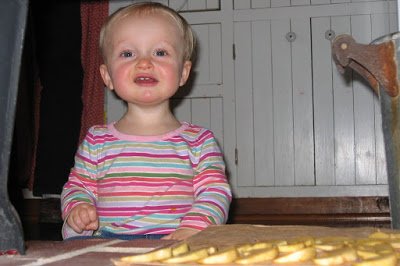
My dad is drying apples these days, under the wood stoves, and N loves them:


Rhyming Dictionary
For Christmas this year M bought me a 1986 Capricorn Rhyming Dictionary (Aid to Rhyme). Its “carefully arranged groupings of the words, and their endings” are not only poetic helps; they are themselves poetic:
ATIC
Acrobatic, anastigmatic, aquatic, aristocratic, aromatic, Asiatic, autocratic, automatic, axiomatic, chromatic, climatic, diplomatic, dogmatic, dramatic, ecstatic, Eleatic, emblematic, emphatic, epigrammatic, erratic, fanatic, fluviatic, hieratic, hypostatic, idiomatic, lunatic, lymphatic, mathematic, melodramatic, miasmatic, morganatic, operatic, phlegmatic, piratic, plutocratic, pneumatic, polychromatic, pragmatic, prismatic, problematic, rheumatic, sabbatic, semi-aquatic, static, systematic, thematic, theocratic, trichromaticIES
Apple pies, cries, dragon-flies, fireflies, flies, fortifies, lies, pies, plies, ratifies, skies, squash pies, supplies, tries, wailing-criesUE
Accrue, argue, avenue, barbecue, blue, clue, construe, continue, cue, curlycue, due, ensue, flue, glue, hue, imbue, ingenue, marble-statue, misconstrue, out-argue, overdue, pursue, queue, rescue, retinue, revenue, revue, ring-true, robin’s egg blue, rue, skyblue, slue, statue, subdue, sue, true, true-blue, undervalue, undue, untrue, value, vendue, virtueRabbit Cake
Hymns Most Relevant
Among the myriad of issues arising from my and subsequent generations’ addictions to television, iPods, and media in general is that many of us have become consumers, not creators. This plays out in many different ways, church sanctuaries notwithstanding. My denomination, which has traditionally thrived on four-part, a cappella hymn singing, is becoming just like any other where passionate praise bands appear to worship cool PowerPoint presentations floating up from LCD projectors.
This change is not happening without reason. Parents who have grown up with hymn singing are worried that young people will turn away from the church because of the old music. Young people want to contribute their musical skills of piano playing, guitar strumming, drum beating, and microphone crooning to their churches. Evangelistic tendencies require reaching out to and including the unchurched and musically nontraditional.
While none of these motivations lacks validity, four-part, a cappella hymn singing cannot be simply left behind as old fashioned, out of touch, or irrelevant. Indeed, closing hymnbooks and opening guitar cases is not as much choosing a more contemporary style as it is neglecting a key component of the true value of church.
To a great extent, joining church is about craving and contributing to something that is greater than the sum of its parts. To hymn singing each participant brings with a unique tone, voice range, and understanding of why they sing. But when they add their voices to the musical fray, they are giving, receiving, belonging—and relying on themselves and each other without external or even technological intervention.
This intense experience of community has not been lost on younger generations. When I was in college, friends and I borrowed hymnals from the campus auditorium and sang out our hearts in a dorm stairwell—for fun. Consistent during the same period was the marked increase in fervor and attendance at every chapel service hymn sing. Just this past weekend, my uncle told me about his middle school boys’ a cappella choir where the boys are awed by the sound that together they alone can create.
Beyond traditional venues, I recall my year of voluntary service in an arts program for prisoners and the intense excitement sweeping through inmates when they were joined by group of really good singers recruited to shape musical rehabilitation. The inmates were incorporated into something beautiful and found themselves contributing and belonging to something seemingly otherworldly.
I’m guessing that if rising generations and even unchurched newcomers are taught to sing four-part, a cappella hymns, many of them will—and quite eagerly at that. They will be inspired by both old and new songs and new ways of singing old songs that reflect our continually evolving theology, ever-broadening community of believers, and increasingly pragmatic hopes.
We’ll need hymnals—and every last person’s voice.
Christmas Composure
A few times M, N, and I have visited a Saturday evening church in town that reaches out to the homeless, the down and out, the addicted. Not that we’re homeless, or even down on our luck right now, or addicted to anything other than life’s simple pleasures, but the unpredictable services in an unconventional meeting place aren’t without a certain luster absent in some of the more staid services we’ve attended where a gilded Bible is raised above bowed heads and a gilded cross precedes robed priests while a pipe organ blasts hymns of processional glory.
One night before Christmas found us on the ragged carpet of the “sanctuary,” late-arrival gleanings from the pre-service supper of burnt soup and crackers on our plates, people sitting about on pulled-up chairs, and kids lounging on a big beanbag in the center of the floor. The crude podium at the front presided from behind a candle stub deposit box filled with sand for later in the service.
At least once a frisky cat, frantically exploring everything from the piano player’s shoes to the idling computer on the cluttered desk in the corner, required ousting from the sand, which it was preparing to use with complete disregard for the riveted congregation’s gaze.
This may sound dismal (and in a way it was), but what enlivened the emotional momentum of the Christmas story retellings was one person in particular. He’d been watching the playing children earlier and laughing loudly in a slightly intoxicated manner, and so I and probably every other parent in the room had had my eye on him all evening.
I’m guessing he’d never heard the Christmas story before. At least it appeared he’d never heard the lyrics of “What Child Is This,” because when we sang “where ox and ass are feeding,” he let out such a guffaw–he laughed and laughed and laughed–that although I knew the tenor line well I couldn’t bear to move my eyes from my hymn book for fear of losing composure.
But what is composure worth, anyway? I’m reading Gone with the Wind, now, for my personal edification, and so far it sounds like an all-American Portrait of a Lady, what with propriety and composure worshiped to absurdity. Most refreshing in that book so far (I’m only into chapter 10) is Rhett Butler, the blockade runner who improperly initiates and then wins a bid to dance with the widowed Scarlett. He tells her, “What most people don’t seem to realize is that there is just as much money to be made out of the wreckage of a civilization as from the upbuilding of one,” scandalous words indeed in that Atlanta hospital for combat-wounded fundraising ball.
To be sure, Mr. Butler is the epitome of self-assured composure, but he scoffs at his fellow dancers’ Southern pride and aristocratic propriety—actually, he riddles it with his contempt. The much-believed-in and celebrated cause he has supported with his excessively high bid for the dance with Scarlett is the very effort he mocks and knows ultimately will fall—the Confederacy.
Gallant, self-confident composure would not last long for those Southern gentlefolk, maybe just as won’t the rituals and sacred habits shrouding some church services, for the truth of the crèche rests with its discomposures. The slimy, messy emergence must have been dismal, the horrific conditions made less tolerable by an onslaught of crude and dirty men most likely steeped in barnyard humor, all there engulfed in the sickly sweet smells of cattle butts and asses. It is perhaps best remembered as a disarrayed scene of desperate making-do where composure’s only value was its diversion of panic.
Indeed, if the manger scene’s human misery were not so palpable, the first Noel would have been laughably ridiculous.
Christmas Birthday
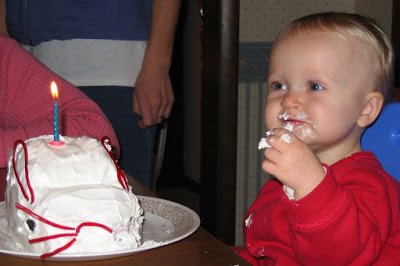
Last year many people gave N many gifts, many of which would have been sorely neglected due simply to overabundance. Ever-pragmatic M squirreled away some of the stuffed animals (including one that had in fact been used as recently as March), and they again became presents for N, this time on her first birthday. We’re thinking of letting her keep her favorite, and storing the others again for later use…
Dance, Snap, Sway