



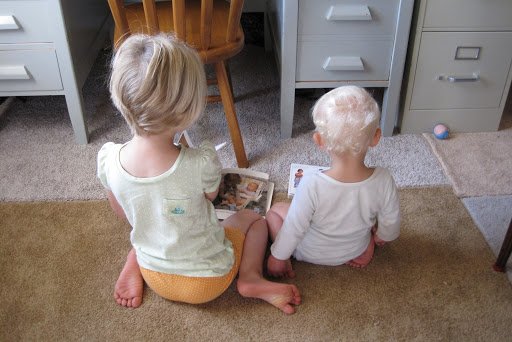
She pretty much always has known how to handle a book, and so of course so has her little sister:
But last weekend she took the whole idea to a new level, to the tune of 70+ pages:
Yann Martel’s The Life of Pi has indeed changed my outlook on life, through beautiful fiction.
But don’t take my word for it: “This is a story that will make you believe in God,” Pi notes; the Los Angeles Times Book Review says on the book’s cover, “A story to make you believe in the soul-searching power of fiction”; the lone reader goodbadi adds, “Pretty sharp poke at religion.”
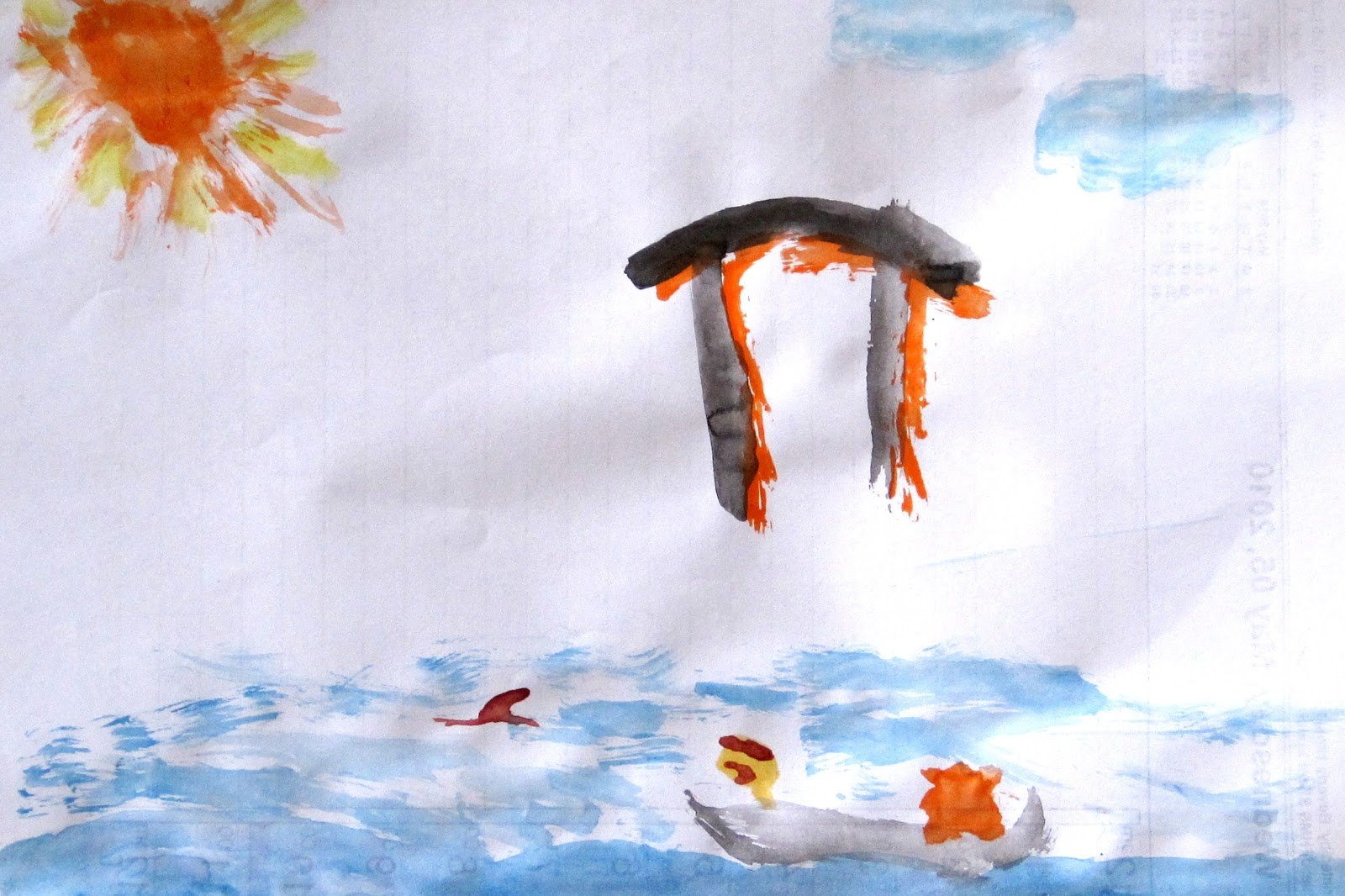
Indeed, this story does just what I think makes a sweet read also great: in its own entity it enacts exactly that which it demolishes by its self enactment, in this case religion.
Pi tells a fabulous tale, one that his skeptics at the end of the novel embrace as True over an alternative explanation. At the same time, throughout the book Pi professes the beauty of his three religions–Judaism, Islam, and Christianity–all of which he accepts as relevant and True. This is exactly what the readers of this book must do, too: even though we ultimately know that nothing in Martel’s novel actually happened, we find it necessary to choose what story or stories–if any–we believe.
The bigger idea, then, is that choosing a religion is a mere selecting of a beautiful tale (or, as in Pi’s case, several tales) to be accepted as True whether or not factual reality is accommodating. Many ardent believers, for example, include Genesis 6:4 in their “True” religious stories: “The Nephilim were on the earth in those days–and also afterward–when the sons of God went to the daughters of the human beings and had children by them. They were the heroes of old, men of renown.” Does this mythologically bizarre story’s presence in sacred text make it true or True, story or Story?
Martel makes his pretty sharp poke at religion by showing appreciation for story–and then leaving it at that. Factual reality is not necessary that which is True. Lower-case story does not beat out Story, whether or not the Story really happened.
I can’t really help it; the role has rather fallen into my lap. Our puppy, as unruly and disobedient and pesky as she is, obeys me more than anyone. Furthermore, my basketball skills simply tear up, especially when I play my seventh grade, asthmatic students the occasional game of knock-out. And finally, there are days when I just know I could through my own bicycle navigational prowess keep the wind at my back (although, admittedly, I probably wouldn’t get home before taking the long way around the world). Indeed, how can I possibly avoid facing an alpha male complex in light of this Truth?
And that, my friends, is beautiful and True in its own special way.
Susan Hasler‘s perfectly titled Intelligence: A Novel of the CIA is one word: s-c-a-r-y. It also made me laugh, buried me in the sobriety of reality, horrified me, and kept me up late just to finish it. But it is, above all else, simply frightening. In fact, it’s so scary I really don’t think it’s a novel, except for maybe the last several chapters, in which–but I won’t tell you, because I highly recommend the book and don’t want to spoil it for you.
More documentary/exposé than fiction, I think, Hasler’s work is a startling warning and, although the supposedly fictitious plot is laced with actual dates and real events, cannot be placed among the annals of historical fiction: its worries and action hearken back not to yesteryear but instead to yesterday, today, and tomorrow.
The bureaucracy of and political maneuvering surrounding and within the CIA are the real culprits of this novel, and the frustration and cynicism felt by Hasler’s characters are infectious. Thankfully they (and therefore readers) find moments of relief from the stresses of their work, but the undercurrent of truth is hard to shelve: cumbersome agencies of “intelligence” are no match for destructive creativity.
SPOILER ALERT…but since I don’t encourage the reading of the reviewed book, go ahead and be spoiled!
The juvenile fiction The Hunger Games trilogy‘s attempt at sketching a “groundbreaking” story of political revolution into more than just an unprofound sequence of horrible, futuristic, seemingly video game-inspired events falls dreadfully short of anything but being intensely captivating.
Katniss is an exasperating protagonist who thinks in sentence fragments and eventually comes to the realization that she’s not a very nice person. Furthermore, while all along she knows she is just a playing piece in the very apparent games of the harsh government, by the end of the third book she becomes aware that she’s also the pawn of rebel leaders.
In the first book, Katniss volunteers to replace her little sister who has been randomly selected to play in “the Capitol’s” greatest annual display-of-power entertainment event in which two children from each of the twelve districts fight to the gruesome death in a highly controlled “arena” that frequently proves itself yet another enemy, all in accordance to the game makers’ whims.
The trouble, she soon learns, is that her district’s other contestant, Peeta, happens to have always been madly in love with her. She struggles to please the games’ television audience–she knows that will bring in helps for winning–that is enthralled with their unfolding, violent love story that will necessarily, according to the rules of the game, leave but one victor. When all the other contestants bite the dust, however, Peeta and Katniss impulsively stand ready to kill themselves rather than each other. But if their poisonous berries are ingested, the Capitol will be left without a winner to celebrate, and so at the last second, the Capitol’s rule of one victor only is changed and both Katniss and Peeta are declared winners of the contest, to live forever in rare luxury, yes, but also, since they so forced the rule change–and on live TV, at that–as de facto enemies of the state.
In the second book, Katniss and Peeta are summoned away from their comfortable lives in Victor Village for an extra round held in honor of an anniversary of the games, in which they again are to be enemies. By the end of the story Katniss learns that she is the symbol of the rebel uprising-to-be–and that the game’s other players know this and are determined to keep her alive at their own expense, in the name of the rebellion. In spite of her naive distrust of the other contestants, her blind need to survive, and her determination that Peeta will be the victor (she knows he is much more worthy of life than she), Katniss and events work together so that the rebels successfully bring down the arena and be swooped to the rebels’ territory.
Finally, the third book details her participation in the revolution as occasional warrior and full-time mascot, her agonizing love for both Peeta and a childhood friend Gale, and finally her marriage.
If my shortening summarizations of the consecutive books say nothing else, I hope they make apparent the diminishing philosophical returns of reading the trilogy. My initial imaginative hopes while reading the first book–that somehow Katniss and Peeta would avoid participating in the society’s violence and instead creatively undermine the evil government’s games through redemptive means–rather quickly eroded away to a sorrowful resignation that in spite of Katniss’s reluctance to kill her contestants, her heartfelt connections with others of them, her naming the games for what they are, her reckless protestation of the killing even and especially by the rebels, and her mental anguish spawned by the gut-wrenching violence and injustice that surrounds her and steals from her close friends and dear family, there is, apparently, no serious possibility in author Suzanne Collins’ worldview for overthrowing a dictator without killing off buttloads of people, and even the puresque Katniss’ ultimate motivation throughout the third book is getting to kill the evil president.
Indeed, the plot not only wholly fails to avoid bloodshed, it also devolves into a list of absurd ways of killing people: Even though the rebel warriors are certainly vulnerable to everyday machine-gun fire (well, maybe except for Katniss, who has extravagant body armor), the booby traps on the streets range from waves of black gel, to spring-loaded nets webbed with piercing teeth, to streets that fold back and reveal pits filled with murderous beings.
In short, although fun to have read, Collins’ thrill-inducing trilogy neglects to provide what textual video game lovers would never think to ask for: fundamentally novel political revolution.
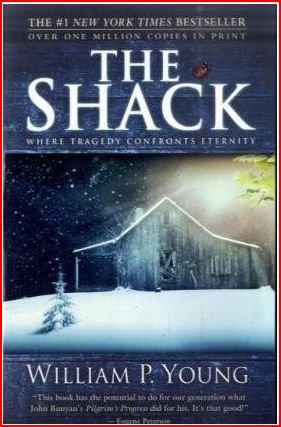 In Wm. Paul Young’s The Shack, a certain Mack suffers what must be a parent’s worst nightmare, gets angry at God, and then is invited to meet with God for a weekend rendezvous where he experiences grace and love and finds the ability to forgive. Judging from a quick look at theshackbook.com‘s community of people sharing “(((hugs)))” from “Papa,” and the testimonial back-cover praise from Michael W. Smith and Wynonna Judd, the book’s popularity seems to derive from an emotional ache in many people, their need for fully unconditional love and communion.
The book is, in fact, a touching and emotional work of fiction, albeit belabored, with poor character development and writing that has me craving some John Ruskin to reestablish my literary self respect. (And certainly some of the presented ideas don’t hold water, in my view. The premise that God is about relationship, not intervention, leaves me wondering why God would allow the nightmare to happen but then would set up Mack’s encounter–an intervention if ever there was one. Nor can I see Jesus telling Mack, “Seriously, my life was not meant to be an example to copy.”)
Perhaps the most helpful part of the book for me is when the Holy Spirit says that her “very essence is a verb. I am more attuned to verbs than nouns.” For example, she says, consider the words “responsibility and expectation [which were] nouns with movement and experience buried inside of them; the ability to respond and expectancy.” Never mind that “expectancy” shares nounship with the two words in question; her point is that “expectant experience” is fluid and emergent, whereas the noun “expectation” is legalistic and laden with performance expectations.
Says she, the Spirit, “Religion must use law to empower itself and control the people who they need in order to survive,” which to me sounds a lot like Nietzsche or someone who wrote that religion came about when weak people, lacking physical prowess, claimed priestly authority in order to survive. But authority, rules, and expectations don’t play into the picture, in Young’s “Papa’s” eyes–just fluid relationships.
The book–and I think this would be the thesis–posits God as loving and forgiving and as grace endowing as all get out, hellbent on relationship with the rest of us (“I will travel any road to find you,” Jesus tells Mack). Young pictures this sort of characterization in creative, interesting, and dazzling descriptions of natural beauty and brilliantly colored, supernatural light shows coupled with friendly theological discussion. It’s shacking up at its best, with a most freeing divine consciousness.
I’ve written previously about a different Mack, one whose faith-redeeming experience consists of meeting not God but the devil. Each Mack’s story is a narrative as told to the narrator, a literary shoring up of the work’s fictional status that allows the narrator–and the author–to be personally unaccountable for any fallacies. That said, a note on the back cover of Young’s book suggests to me that this literary creating of a highly personal, warm, and (in some ways) interested God is not expected to be considered as mere fiction: “[Young] suffered great loss as a child and young adult, and now enjoys the ‘wastefulness of grace’….” Should I read this book as an interesting novel, or as a spiritual guidepost, or as the fruit of extensive trauma therapy? Or all three?
The dismissal of personal spiritual experience is not my aim, but I wouldn’t mind discounting inaccurate expectations regarding getting warm and fuzzy with God (as if I possess the expertise to do any of these things!). Unfortunately, The Shack seems to set up such a system of expectation–but even as it does so, it maybe inadvertently disallows even that system. In the book, after Jesus says that he is loved by people “from every system that exists,” Mack asks, “Does that mean that all roads will lead to heaven?” Jesus replies, “Not at all. Most roads don’t lead anywhere.”
“Warm and fuzzy,” in my book, is one such road–which should be replaced with a spirituality of “ambiguous expecting.”
In his text Simply Christian: Why Christianity Makes Sense, N.T. Wright attempts to weave all of biblical history and the development of Christianity into a supposedly simple, watertight TV-dinner package. The book, which we’re currently studying in Sunday school, doesn’t really work for me, perhaps because it’s a rather complex attempt to tie so much together into one knot. Some things Wright says are, I would venture to guess, on target. For example, he asserts that the universal human longings for justice, spirituality, beauty, and relationship all point to the presence of a bigger, as-yet-unrealized reality that is God’s kingdom. However, he limits the entirety of the human experience to any of three options for understanding God’s association with the world: God is an entity entirely separate from earthly reality, God is in everything (and yes, that table over there is God), or God’s realm intersects with the earthly realm in Jesus (God’s “rescue operation”) and his followers.
I wonder if there couldn’t be a fourth option for understanding our interaction with the divine. Here it is–a succinctly summarized, universal, non-heady, truly simple platform on which Christians can be living contributors to the kingdom of God here on Earth: God is love, Jesus embodied that love, the spirit of God resides where there is love, and the ultimate ethic and morality is to act in love, a love that includes the offering–and inevitable receiving–of grace and forgiveness. One of my university Bible professors asked this question, which I think helps us muddle through how this fourth option is to be played out: “Is ______ life giving or death dealing?”
(By the way, this was the same professor who assigned readings by Walter Brueggemann, whose comment on the back cover of Wright’s book reads, “Readers will welcome such ready access to one of the fine teachers of the church.”)
I say that this fourth option is “simply Christian” not because it’s easy, but because it lays to rest many oft-debated, bogging-down theological and doctrinal points such as biblical infallibility, the virgin birth, the afterlife, the existence of miracles, the meaning of the crucifixion, etc., and instead challenges each and every person to immediately practical godliness.
