What would happen if we had a nationalized health insurance system in which user fees were not based on projected expenses but were post-op? (In other words, all of the health care costs from 2010 would be tallied up and divided using a sliding scale, and payment would take place when people figure out their 2011 taxes.)
- Most appealing about this to me are the removal of any profit motives on the part of the insurance provider, the elimination of risk expectation variability in cost determination, and the national unification that would form around everyone encouraging everyone to be healthy and therefore wealthy.Wise?
The Day I Joined the Military: A Fictional Account of Something That Never Happened
It finally got to me, so today I took the first step for making a positive contribution to the world.
It actually started way back in 1998 when my sister and brother-in-law were in Nicaragua during Hurricane Mitch. They weren’t coastal residents, but their normally fragile communication links were wiped out by the storm, so no one in my family knew for several days how they’d been affected. When we finally heard from them, and that they were fine, they told us that we’d not been the only ones concerned–a U.S. military helicopter had flown over their house, just checking in.
A military helicopter? I turned to my communal housemates there on our pacifist campus, tears streaming down my face. “It makes me want to enlist,” I said. “After all, the military does have the equipment to help out in these situations.”
And now the earthquake in Haiti has happened, and again the U.S. military has rushed to the rescue. According to Time last Wednesday, “Some 800 Marines moved ashore Tuesday in Haiti, ferrying supplies on helicopters and Humvees as the U.S. military force there swelled to as many as 11,000. Military officials said troops and supplies were arriving as fast as possible despite daunting logistical hurdles. Army Maj. Gen. Daniel Allyn, the deputy commander for military operations in Haiti, said the military has delivered more than 400,000 bottles of water and 300,000 food rations since last Tuesday’s earthquake.”
Sign me up! I thought when I read this. Let me be the compassionate arm of the U.S. government! Give me a machine gun or even just a water bottle!
After a sleepless night during which I told M none of my intentions, today I called up a local recruiter I know. He actually comes to my school and speaks at our pep rallies about valor, courage, and cool weaponry, so he was eager to talk to me.
“Say, Randy,” I said. “I want to sign up for the Marines. I want to go to Haiti right now.”
“Sure,” he said. “Let me get your info.” I obligingly answered his questions: I’m straight, I’ve never been convicted of murder, I’m pro-life, winning a Nobel Peace Prize sounds good to me, and yes, Diet Coke heated in the desert probably wouldn’t be too bad for me to stomach, although why would I ever be deployed to a desert somewhere when Haiti’s just around the corner?
“Do you speak Pashtun?” he asked. “No? Arabic? Korean? No? OK, uh, how about, do you read any of those languages?”
“Nope,” I said. “But why does that matter? Bottled water and goodwill gestures need no spoken words. Love is the International Language.”
“Right,” he said. “Now, how much experience do you have with guns?”
By this time, so in a hurry was I to begin dispensing relief to our needy neighbors, I’d just begun to tell him the answers I thought he wanted to hear. “Lots, since I used to be a rabid hunter. And I shot a tin can on my first try with a .22 revolver.”
“Good, good,” he said. “You’ll make an excellent Marine. We’ll sign you up for boot camp starting next week.”
“Next week? Boot camp?” I asked, rather incredulously. “But the Haitians need help now! I don’t have time to train. I’m a good driver–can’t I drive a big truck without boot camp? Can’t I learn on the job how to operate a walkie-talkie? And handing out supplies doesn’t require that much expertise–just access to the goods and transportation capabilities, which the U.S. military in all its potential radiant glory has!”
“Uh, right,” Randy said. “But you really do need to know how to shoot straight so you don’t hit one of your 68,000 fellow soldiers on accident. You know, friendly fire never looks good.”
“68,000? There are already that many soldiers there? That’s, like, a heck of a lot! We must be doing lots of short-term, high-impact, shock-and-awe emergency relief sort of good! But I read in Time this week that they’re expecting ranks to swell to only 11,000 on the ground.”
“Only 11,000? In Afghanistan?”
“In Haiti. You know, strictly humanitarian. I want to go to Haiti and other places and use your equipment to reach people who need help fast. Just think of the military’s capabilities! Swoop in, give food, water, help, access to medical attention, and start rebuilding! No other relief agency anywhere can match it!”
“Oh. Um. Can you call back later?”
Refreshing Ethics in Action
A while back I wrote about presidential personal and corporate ethics. While I can’t say that I agree with everything President Obama has done so far or will do in office, he has my complete respect for his response to his response to the Henry Louis Gates, Jr. arrest.
Now, I’ll just note that Gates and I shared (albeit many years apart) an English professor–and that I once met Gates and told him as much, a comment that he seemed to appreciate. Believe me, the fact that I have spoken in person with Gates–who very well may soon meet Obama for a beer–makes me very, very special.
[UPDATE (7/30/09): The beer fest happened.]
But the real news here is that we have a president who is bold enough to step up to the plate and not only admit he acted or spoke inappropriately but is taking brave initiatives to meet with the very parties he offended.
That is indeed refreshing–as is this video of the Obamas’ opening of the poetry jam in the White House a while back.
We Defeat Ourselves
Implicit in CIA Director Panetta’s statement that the “disclosure of explicit details of specific interrogations” would be “propaganda [that al-Qaeda] could use to recruit and raise funds” and would be “ready-made ammunition” for the organization’s cause is acknowledgment that the U.S. has not been acting in its own best interest.
The debate over whether or not “harsh interrogation techniques” are okay is over, and the victors are those of us who willingly sacrifice torture’s (ever-so-slightly potential) benefits in the name of not becoming terrorists ourselves.
Not only can we claim (an albeit simple-minded) moral and ethical (I use both terms because I don’t know the difference) higher ground, we also now know–the CIA’s even said it–that doing bad things to people makes us less safe.
Stimulus Opportunity
M told me one evening this week that she is sometimes brave. She had baked two loaves of two different, new kinds of bread, both of which she planned to take along with us when we would go visiting later.
“I often regret trying a recipe on other people,” she said, “but I’m doing it again anyway.”
“If I were a demanding sort of husband,” I told her, “I might insist that you not practice such generosity without first testing the goods on me. But I’m not demanding, so you just do whatever you want.”
A bit later, I heard her say that she suspected that the loaves had perhaps been under baked. We had an early evening bedtime snack that both confirmed her suspicions and stimulated my sweet tooth mentality.
Such fortifications by us for the greater good are not only tucked into our little bellies. M and I have shared our contributory spirit beyond ourselves and indeed have sped up the world’s economic recovery as best we can–by borrowing a butt load of money and giving it all to a family we don’t even really know and who are planning to spend all of it on new house construction over the next few months.
You could call it a privately financed (by us) stimulus package (never mind that the recipients of the money gave us their current primary residence in return).
But as pleased with ourselves as we are for contributing to our dear nation’s fiscal survival, we know in our inner beings that there remains much more we yet can do, and I hereby–totally altruistically–offer us as Ideal Stimulusees.
See, in this economic downturn, not spending money–or at least saving it under a mattress instead of investing it in stocks–promises only to perpetuate the downward spiral of worry, unemployment, personal rejection of spendthrift habits, no tax revenue, no jobs for government workers…you’ve already gotten the picture, no doubt.
Money needs to flow–and it needs to flow through people like us. As I am a member of an only moderately lucrative profession, our few monetary resources and the possibility of an upcoming salary cut make us the Perfect Recipients of stimulus. The current shallowness of our bank account ensures that any money we receive will be spent very quickly, and not on flashiness but on things for our new home that will increase our energy efficiency and conservation as well as domestic food production.
Deep down, and primarily out of concern for others (well, mostly each other), M and I really, really, really want to contribute.
So bring on the stimulus!
Untimely Presidential Note(s)
I sent two emails to President Obama this weekend in a feeble attempt to get him to revamp entirely the almost-finished stimulus package.
The first stated, “I voted for you and am excited about these four years.” That’s all the further I got before hitting the “enter” key–you know, to start my next paragraph–which the White House interpreted as “submit.”
But that wasn’t all I had to say–and so I filled in the contact form all over again, typed my full message, and clicked on “submit” again, only to receive an error message.
I heaved a huge sigh of humiliation–Did the President not want to hear from me? Am I so horribly technically unsavvy?–and reloaded the contact form before plodding through the form and message composing for yet a third time:
“President Obama, I voted for you and am excited about these four years. I am, however, disappointed by what I am hearing about the stimulus package. Please do something radical and address the root causes of our nation’s problems by following the advice of economists like Greg Mankiw. Thank you.”
Now I’m waiting to hear about the current stimulus package’s last-minute crumbling so something truly transformative can take place.
Waiting…
Waiting…
Still waiting…
Tax Record
Just to get this out in the open before Obama calls me up to offer me a new and prominent cabinet position for which the job description will be “Whatever goodbadi Wills,” let me just state that I have been a conscientious taxpayer (unlike certain other cabinet nominees).
In the name of full disclosure, I will note that there was an equally conscientious burp–more like a hiccup, really–in my taxpaying history back a few years ago when I decided that paying war taxes made me as guilty of murder as anyone else (a premise with which I still agree). To ease my aching soul, therefore, I withheld some of what I owed Uncle Sam and sent it off to a church international relief agency to build peace instead of bombs.
Soon after filing, though, I realized that the potential complications resulting from not paying all I owed would perhaps prevent me from doing more good than my paying the full amount of taxes would do harm. I quickly mailed off a corrected form, and the IRS and I have been on benevolent terms ever since.
I should note, too, that I have never been audited, which means I really don’t know if I’ve ever inadvertently cheated the government or myself in the reporting process. Until such an audit takes place, however, I have no other option but to claim accountability and maybe even moral superiority over the above-mentioned certain other cabinet nominees. I’ve never failed to pay taxes on my chauffeur service. I’ve never failed to pay unemployment taxes on my household help. And I sure hope I’ve not racked up more than $48,000 in back taxes and interest, since in all my life I’ve hardly earned three or four times that amount.
The obvious problem, of course, if we give these certain other cabinet nominees the benefit of the doubt and chalk them up as law-abiding wannabees, is that even the folks who supposedly pal around with the very people who write and enforce tax laws can’t or at least don’t understand the code enough to follow it.
If we don’t give them that benefit of the doubt, the obvious problem is that our laws are written by a bunch of crooks who really are right to withdraw from their appointments and leave some cabinet space for the rest of us.
Dear Mr. President: New Car Needed
During Obama’s presidential campaign I appreciated his nuanced assessment of the abortion rights debate. I didn’t appreciate his we’re-going-to-track-you-down-and-kill-you approach to terrorism. In his first days in office, he acted in both areas.
This week Obama overturned a law disallowing U.S. dollars to support family planning groups involved in abortions. “This should serve as a bitter pill for those who campaigned for him, all the while proclaiming their belief in the cause of life and family,” NPR quoted one abortion opponent.
While I haven’t researched the overturning beyond NPR’s precursory skimmage, I would wager that the abolishment effects hugely complex ramifications not all of which result in abortions. That said, however, to any pro-Obama-er who, like me, is also pro-life not just in pre-birth matters, this move–if indeed it does result in increasing abortion rates–by the new president is as unjustifiable as his approval of so-called anti-terror military strikes.
I’ve been writing recently about the children devastated in military conflict. Obama’s actions this week have furthered this evil devastation in no inconsequential way. According to The Guardian, “Obama, in his first military action as president, sanctioned two missile attacks inside Pakistan on Friday, killing 22 people, reportedly women and children among them. The attacks drew criticism from Pakistani officials at the weekend. Pakistani president, Asif Zardari, told the US ambassador to Islamabad, Anne Patterson, that the strikes ‘do not help the war on terror.’ According to reports, he also warned her that ‘these attacks can affect Pakistan’s cooperation in the war on terror.'”
I think it’s rather obvious that the war on terror is about as silly and counterproductive as is the war on drugs or was Prohibition. The best way to deal with any of those problems–terrorism, drug abuse, alcoholism–is not to outlaw them or to fight them but to dig out their roots. These self-destructions need to be pre–empted through the cultivation of concrete opportunities and founded hopes that usurp the desperation that lures people into such behaviors.
Similarly, both the expansion and limiting of abortion have one thing in common: neither deals with the underlying social ills that supply the abortion industry with clients. To say otherwise would be like claiming that encouraging people to eat junk food–or outlawing it entirely–will solve the problem of people not growing their own tomatoes.
I resonate with selected concerns aired by Frank Schaeffer back in campaign season: “We can’t [reduce abortions] by concentrating on politics, or silver bullets such as trying for that one magic court appointment. It’s the ‘holistic’ approach that is really what’s important if our goal is to reduce the number of abortions rather than just ‘win’ political games…. What kind of care do we provide to mothers and children? What is our educational system like? Is health care available to all? Do our preschool programs and everything from paternal and maternal leave to the economic well-being of our country come first? Or do we argue about abortion rights while we live lives of such supreme selfish decadence that the nature of our country means that no matter what we do with the laws about abortion life will not be valued?”
We need to pre–empt abortion through myriad concrete opportunities and options, not the least of which are better adoption processes that allow caring parents to welcome adoptees into their homes without ridiculous delays and legal encumbrances. M and I know personally two loving couples our age who are at different stages in the adopting process, and it’s no less than nightmarish, considering their frustrated willingness to meet needy children’s needs.
From-womb-to-tomb pro-lifers concerned about abortion, military action, and counter-terrorism need to demand the crystalization of the change so welcomely promised by our new president over the past year. In a sermon this morning one pastor said it approximately in this way: “We have a new driver, but we’re still in the same car.”
Dear Driver: Our nation needs a new car.
Tapping Past Passions
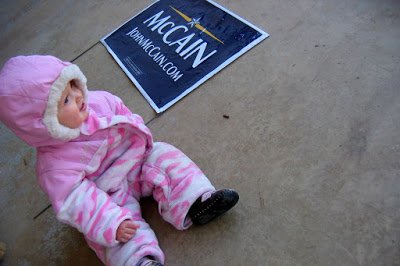
Well, after all was said and done, I pilfered (with permission) the John McCain campaign sign that a well-meaning neighbor had placed in M’s parents’ yard. They’d immediately brought it into their garage, where it stayed put until I spoke up for it.
“I’ll put it in my parents’ yard when they’re not looking,” I said.
During our next visit to my parents, I excused myself from the late-night Scrabble game. “I should bring in N’s backpack,” I said, “so it’ll be ready for our hike tomorrow.”
In the pitch black dark of the cloudy country night, I stole down the driveway, groped for the roadside, and shoved the sign’s wire legs into some soft ground. The next morning, Dad claimed that a student had played the prank on them.
I hid my face behind the newspaper he’d just brought in and gave myself away with, “Really? It wasn’t there when I went out for the backpack last night.”
Of course, they didn’t want the sign, even if the polls had been closed for nearly two months, so I stowed it in our trunk once again, plotting a future placement at my sister‘s house.
The opportunity bared itself this past weekend, when she invited us over for a sampling of her latest food tremendosities. I made sure to park the car near the road, and before we left, I again stumbled to the roadside and planted the sign.
The next morning, M emailed me the details:
“She just called–she found the sign and thought it was pretty funny.”
“She knew it was us?” I wrote back.
“She asked if I did it–‘No.’–Then if you did it, and I confessed. We must’ve been primary suspects.”
Us? Suspects? Well, okay.

Pudding in Perspective
Even pudding–lots of it–can’t make the world entirely palatable.
In a fit of misguided foresight earlier this week I made not one 8-ounce serving per upcoming school day but, instead, the whole dang bag of instant chocolate pudding. It was Monday night–with but four packed lunches to go, my friend–and I made seven servings, plus a large cereal bowl full of the stuff. I used all of the milk M had mixed for us (skim with whole, since we like 1% or 2% but N’s supposed to have whole), for which I felt kind of bad but only until I saw that there was still plenty back.
Since then I have been faithfully imbibing the stuff. We ate the bowl on Tuesday night for desert, and every day I took one serving to school for lunch, except for Thursday, when I rode my bike to school. I ate two that day, one for lunch and one just before riding home. It gave me quite a boost.
It’s a good problem to have, mind you, in comparison to what so many other people have to deal with, which is what I learn about at lunchtime at school. That’s when I usually I grab my bread and cheese and (this week) pudding and sit down at a computer to listen to NPR’s hourly news updates, surf other news outlets, and watch Reuters news videos. It’s my junkie time.
Lately while I’m watching news, though, I’ve noticed a side effect of my increasing enamoredness with N: I find it unbearable to watch news of children harmed–and there seems to be no shortage of imperiled children, most recently in the midst of the Israeli-Palestinian atrocities. In Gaza, “as many as 257 children have been killed and 1,080 wounded — about a third of the total casualties since Dec. 27, according to U.N. figures released Thursday,” says MSNBC.
The pudding appeal pales, but that’s the least of humanity’s worries.

