• goodbadi

    A Resurrection Connection

    Occasionally people boil faith down to requisite belief in strange events that as actual happenings perhaps bear no more relevance than might they as merely metaphorical stories.

    Jesus was on to something when he taught in parables, which invite not belief in a certain historical account as much as an interest in learning from a story. Parables allow for active reading, finding ourselves in the text, making the stories’ lessons relevant to our lives–without the encumbrance of “I believe this actually happened” discussion. It makes no difference whether or not the rich man’s barns actually existed or the misguided steward actually buried the money; the points of the stories are applicable to our lives today anyway.

    We pick and choose, of course, which parts of the Bible to understand literally or parable-y. No one in my discussion group the other Sunday seemed to take seriously the idea that we’re all gods, even though Jesus says quite plainly in John 10 that we are, but when Jesus’ resurrection in John 20 rolls around, we’re all textbook.

    As is the case with any historical, religious and/or spiritual event, whether or not I claim the resurrection story’s literal factuality makes absolutely no difference when it comes to what really took place. What’s more, maybe such claims–to either effect–don’t even affect the praxis element of my faith.

    On Easter one of my pastors in his meditation raised the question, “In what way does Jesus’ resurrection make a difference to you?” Then and in ensuing discussions people mentioned, “It gives me hope that death doesn’t have the final say,” “It’s important to me to have a living leader,” “I need to know that every day is a new day so I don’t get discouraged.”

    My contribution to the conversation was largely skeptical: “I don’t know that [the literal resurrection story] does make a difference to me, or makes me live my life any differently. And as for defeating death, I’m not sure what’s the big deal; Lazarus had already been raised from the dead.”

    I just might agree with myself that an all-powerful being’s literal coming back from the dead, while a pretty cool trick, is not really that surprising a stunt, the universe and all else considered. That said, the resurrection story is central to my faith: people can have fresh starts; new breath can be infused into situations hopeless; today’s a new day to give life a go. Ultimately, the challenge of grace that is central to Christianity didn’t end with Jesus’ murder but somehow lives on at the core of the Christian story, be it literal and/or metaphorical.

    Either way, when the sun comes up tomorrow, resurrection will again be born…again.

  • goodbadi

    Thrift

    A local, church-based thrift store is called “Blessings and Treasures.” I guess sometimes there’s a discrepancy between the two.

  • goodbadi

    To Pass Over

    In my denomination’s recent history, communion has sometimes been somewhat ominous; I’ve heard stories about how church members were required to appear individually in a closed room before the elders for spiritual examination before being allowed to take the meal. People “unsaved” or with unresolved sinfulness were not welcome to partake of the juice and bread, since taking it without the proper preparation, seriousness, or faith credentials merited weighty divine paybacks.

    This strictness is changing: I have never been examined, and in most churches I’ve visited the only communion caveat is to partake only “if things are right between you and God and everyone else.” Unbaptized kids are often welcome, too, although they might be handed grapes rather than the wine or juice. I’ve appreciated this liberalization of boundaries.

    However, these more loose communion practices, like traditional ceremonies, often are framed as part of remembering the Passover. It was at the observance of that Jewish holiday that Jesus served that first communion, and we have concluded that “do this in remembrance of me” means to continue coupling the two. This unfortunately only furthers the accentuation that God chooses sides, in the Exodus story’s case the side of the Israelite slaves, on whose behalf the Egyptians’ firstborn people and animals were killed.

    Now, the Passover story is part of all that is hugely relevant to the history of the Jewish people, to any underdog movement needing inspiration, and to anyone who wants to understand Western literature. However, it is, like many other Old Testament stories, mostly relevant to non-Jewish, contemporary Christians because it informed the context into which Jesus was (to some, so rudely) plopped and, in this case, which he confronted–by voiding litmus tests for joining with the religious “in” crowd. Did not Jesus himself serve communion to–of all people!–Judas Iscariot and Peter? In short, Jesus so threatened (in part by eating with questionable characters) the religiously right’s self-righteous boundaries that he was arrested–and during the very celebration of Israel’s chosen status, at that.

    I appreciate and believe that, as the Exodus story suggests, God does care about (and maybe even side with) the downtrodden. Jesus did, too, after all (and so does the Statue of Liberty). That’s scary, as I’m not particularly downtrodden, which means I’m probably downtrodding. Even scarier is Jesus’ declaration of who really is “in”: “Anyone who loves me will obey my teaching. My Father will love them, and we will come to them and make our home with them. Anyone who does not love me will not obey my teaching.”

    Jesus blurred Pharisaical “saved” versus “unsaved” dichotomies by eating with many different stripes of sinners, even at his last supper. This effectively frees communion from excluding or delineating schemes that deny bread and wine to people just as eligible as anyone for becoming the everyday body and blood of Christ.

    Instead of continuing to tie communion observance to the story of the Passover and framing it as a special ceremony reserved for a special “in” crowd, perhaps the world would be better served if communionists celebrated, as holy communion, the meal that Jesus took with Zacchaeus, where the only prerequisite to pulling up a chair was interest and the outcome of joining in was change for the better.

  • goodbadi

    Fat and Skinny Mashed Potatoes

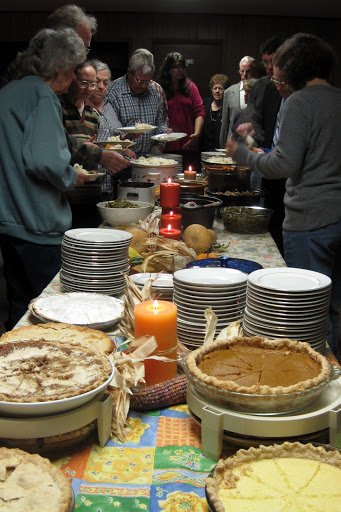
    Yesterday our church canceled the morning service and instead hosted an evening Thanksgiving feast preceded by a pinata for the kids and a hymn sing for everyone.

    When we tallied up the numbers a week ago, we figured about sixty people would attend–and so prepping food for seventy seemed reasonable. Considering our bumper potato crop, M and I offered to bring mashed potatoes to go along with the gravy, ham, turkey, sweet potatoes, green beans, rolls, cranberry salad, pies, and hot tea and coffee also on the menu.
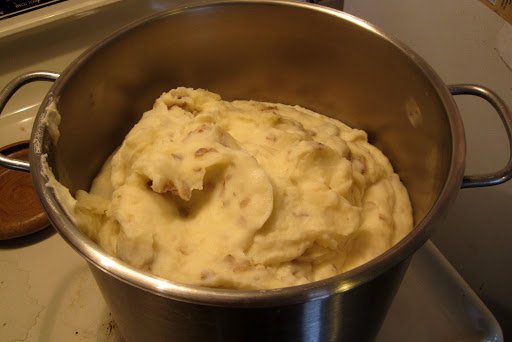
    Saturday we scrubbed three quarters of a bushel of potatoes (someone had told us that half a bushel would feed around forty people), and Sunday morning I crammed them into our four largest cooking pots for boiling, and then mixed them, peels and all, with what sounds to me like a piddling two pounds of butter, lots of salt, and a gallon and a half of milk. We smashed them into waiting crock pots in our new kitchen, with the overflow two-thirds filling the smaller of our biggest kettles keeping warm on our current kitchen stove.

    The feast was a tremendous success, lavish, delicious and festive. M had spearheaded the decorations, and all was autumnal and warm; she also led the hymn sing most elegantly.
    And she helped me cart home the one empty, the one nearly empty, and the two filled crock pots–and the still untouched big kettle.

    Check out who is at the back of this beginning of the line–our western landowner neighbor and her husband:

  • goodbadi

    Thanks, No Thanks, Thanksgiving

    Long ago, after we sent a letter to our western neighbor saying that we planned to install our own water supply system and therefore remove the electric line that comes from our house and powers her barn along with the pump we share, the nice man from the electric company told me that our western neighbor would be happy to pay us twenty dollars per month–the minimum charge if she had her own hookup–for continued access to our electricity.

    Up unto that point–forever, I suppose–she had just used it for free; I contacted her and arranged that she would start paying us. And she did pay us, for four months at a time, albeit almost always about a month late and sometimes with a check written in pencil, for well over a year.

    Back in August, though, in a rush of wanting to build a spirit of goodwill with my neighbors, I called up the western neighbor and suggested that she cut that twenty dollars in half.

    “Oh, whatever,” she said. “I just do whatever people tell me, anymore.”

    “Well, if you want to lower it to ten dollars starting in September, that’s fine with us. You’re not using twenty dollars’ worth, I don’t think.”

    “Well alright,” she said, and then she said something she’d never before said to me: “Thank you.”

    (If that didn’t make me giddy enough, I immediately called the eastern land renter and offered that he make hay from our little field since I was going to have to pay someone to cut the grass, anyway. He said he wasn’t going to be bringing his equipment over anymore this fall, but–another new experience here–“thank you.”)

    Well.

    As September came and went and no check arrived from the western neighbor, I started to fret. As October, too, sneaked by, I considered our options. It wouldn’t do to call her and remind her that she hadn’t paid; simply because I would be asking her to do something, I was pretty sure that, as a matter of principle, she wouldn’t respond by sending a check. And I didn’t feel like spending our windows money on actually separating the power supply and water setups, so that wouldn’t work.

    Then, like any good, divinely inspired institution should, our church came to the rescue–by deciding to host a Thanksgiving feast and invite friends and acquaintances.

    Guess who received one of the invitations.

    Guess who put that check in the mail lickety-split.

    And guess who feels much better.

  • goodbadi

    Jonah’s Rant

    I’ve referenced Matthew 18:21-35 on this blog not terribly long ago; as I said in church this week when we studied this Parable of the Unmerciful Servant, it doesn’t feel good to be on the wrong side of a Bible story. 

    Anyway, as preparation for Sunday’s service I wrote this as a summary of Jonah, which we studied along with the Matthew passage:

    I have a burning, righteous sense of indignation about what God is doing here. I mean, I come here with what he told me was a pertinent message: Serious extermination, folks, in forty days! Look out, Ninevah!

    I almost didn’t come. I tried not to, anyway. God said, “Go to Ninevah,” so I left in the other direction. Ended up telling the ship crew to throw me overboard. Ended up being swallowed by a fish. I always hated playing sharks and minnows when I was a kid, and here I was, in some serious bile.

    Told God that while other people worship worthless idols, I shout grateful praise, even from inside the belly.

    Ended up as fish vomit on a sandy beach somewhere, slimy and good for nothing but doing what God told me to do.

    So I went to Ninevah, preached hellfire and brimstone. Smelled like undercooked fish. Wore out my sandals. Sat down outside the city to watch the destruction.

    And you know what? That king that I’d condemned told everyone in that blasted city to repent, to end their evil and violent ways–and maybe God wouldn’t destroy them.

    And they stopped being so bad, and God said, “Okay, no destruction for ya’ll.”

    ‘No destruction for ya’ll’? When did God turn all friendly like? I hadn’t known there was a ‘grace and compassion’ clause in my deal with God! No way, man–that’s not what I came for. I came to say down with you downers.

    I’ve had enough of this rubbish. Repentance! Huh. I didn’t put up with no fish bile for this kind of slobber. I’m just going to sit here and die. After all, I’ve wasted my time–I should never have left home. Abounding love and mercy–surely God could have come up with that on his own without bothering me. Fish bile!

    And I’m right to be furious, too. And I have a right to this here nice bush that just grew up over me and my shed last night to keep me out of the sun and give me comfort.

    But whew! That’s a mean east wind. Hey, where’s my tree going? Hey! Where was that tree-eating son of a worm when I could’ve used some substitute fish bait? This is really fishy. I wish I was dead.

    And yes, I’m right to be angry, even if I didn’t grow this withered plant. What was God thinking? Mercy and grace and forgiveness–and for those losers, who can’t tell their left and right hands apart? Losers! And their pets! Bah, humbug.

    Any big fish in that town? I’ve got a worm for them to share.

  • goodbadi

    In Whom We Have Faith

    The story of Jesus calming the storm (Mark 4:35-41) is often used as a textual basis for “Do not fear, God is here” type pastoral lessons, but that idea, that God is out there looking out for The Fellowship, bugs me at times.

    Take that Psalty song “Say to the Lord ‘I Love You’” on one of N’s tapes, in which children talk about their love for God. N has taken to reciting these anecdotes, including the one I find most appalling: After looking so hard for a lost baseball, a boy closes his eyes to pray. When he opens his eyes, there is the baseball, at his feet. “I love you, Lord,” he says fawningly. How unfair for Psalty’s child listeners to be taught to expect that kind of guardianship!

    While I’m not sure what exactly it is that the Mark story does teach, it seems to me that its message might not be about casting all our cares upon Jesus. In fact, in a way it teaches the opposite, since after the disciples wake up (pray to) Jesus to tell him of their plight, he scolds them: “Where’s your faith?” he asks. I wonder if he followed that with, “In me? Jeesh, I hope not!”

    Now, of course the disciples got what they wanted—the wind and waves were calmed—and presumably their question “Teacher, don’t you care if we drown?” was answered with decisive divine intervention.

    But they also got a tongue lashing? So, then, in whom exactly are they to have faith, if not Jesus? The problem-solving power of group thinking? Positive outlooks even in the face of adversity, in this case thinking about their boat more as half empty than half full?

    I don’t have answers to these questions, but today’s NPR story about a hate-crime victim fighting for his attacker’s life is a storm-calming testimony.

  • goodbadi

    Bovine Diplomacy

    Author’s note: A college prof once told my class that it’s better to be honest than good; my brother’s wise idea for this blog’s title suggests that both my better and lesser points are, after all, me.

    Up until this week I tried polite diplomacy.

    Here’s the back story: The cattle owned by the Land Renter (LR) who is renting the farmland on three sides of our property have escaped onto our land many times. When I’ve called him he has always come to herd them away and presented feeble fix-it attempts; on one occasion he rather bluntly pointed out that the “first problem” to deal with were the tree saplings we’d planted apparently too close to the fence (maybe an issue five or ten years down the road). He also said that the cattle-trodden fence sections on the Western Landowner’s side wouldn’t be a problem, since they didn’t have cattle there now, anyway.

    I also called the very apologetic Eastern Landowner, and we exchanged assurances that he would replace the fence at his expense (since we’re not using it) and we would be moving our saplings farther from the fence line to prevent any future problems.

    When I called the Western Landowner, she merely said she’d look at the fence; a few days later we did in fact see her car slow while driving by.

    And then this week:

    On Monday, LR’s high-school just-graduated son herded their heifers into the above-mentioned Western Landowner’s section of pasture directly adjacent to our garden and separated from our land by a flimsy fence with at least two unrepaired sections that the cattle have crossed a number of times before. I was napping at the time, and watched foggily from my bed as the herd stampeded into their new domain. I jerked myself awake in time to run out to flag down the son just as he rode his four-wheeler over to the fence.

    “There are several bad sections of fence along here,” I said, pointing them out to him.

    “I was just coming to check them,” he said.

    “I think the cattle have gotten out down here, too,” I said of one place where the fence was stretched and bunched down.

    “Have you seen them get out there?” he demanded. “It looks to me like they just pushed against it there.”

    “No, I didn’t see that. But it needs to be fixed. These sections need to be fixed before your cattle are in here.”

    He got off at the uppermost broken spot, and with his bare hands pulled and twisted together some of the severely damaged woven wire, and then got back on his four wheeler and looked at me.

    I looked at the twisted wires, and then at him. “I’m not convinced.”

    “I don’t think they’ll get out,” he said.

    That’s when I decided that what my mom would later wonder about is right: some people don’t understand the language of courteous neighborliness. I had a miniature explosion.

    “You’re telling me that we have to be concerned about our garden—which we put a lot of hard work into—because you run shitty fences. That’s ridiculous and unacceptable.”

    He turned sulky and said, “We can put the gates [which he’d used to patch the Eastern Landowner’s side’s vulnerabilities] over these spots. Can we cross your land to do that or do we have to drive all around your property get them?”

    “Thank you for asking permission to cross my land,” I said. “Let’s do it now; I’ll help you.” We talked about his and his brother’s schooling while we worked, and ended on good terms albeit with a customarily feebly fixed fence.

    My only regret was that I’d said the “shitty” line to him and not to his dad.

    Then.

    Yesterday we went to visit my parents, and I worried we’d come home today to trodden vegetables. My spirits lifted, though, when we came back to see that all the heifers were in their confines and our garden was as we’d left it—in need of potato bug collection, which we hopped right on.

    As we finished up picking the bugs and weeding the onions, a man I’d never met before stopped in to ask if we plan to use the pile of rocks in our pasture (we do). As I talked with him, M, still down at the garden, called for me—a heifer had just then jumped yet another section of fence and was munching our corn.

    I ran inside for some leather work gloves and the rope I’d made handy after Monday’s relocation. The man seemed willing to help us, so I said, “I don’t want to chase it back across the fence—I want to catch it.”

    We tried and tried to corner it and rope it (“You should take lasso lessons,” he said) until finally with our dear dog’s, M’s, the man’s and my coordination, we corralled it in between our two woodpiles facing what I thought was an impermeable section of fence and blocked behind with a pallet tied to some other fence posts.

    I started making phone calls, first to my brother-in-law: “Do you know anyone with a cattle trailer we can borrow?” He didn’t, but suggested I try a neighbor down the road. They didn’t answer the phone.

    I called another neighbor; they didn’t have a trailer.

    Meanwhile, the cow in the makeshift stall was denting the metal trash can of kindling I keep there and occasionally backing towards me as I leaned against the pallet, poking her with a pointy stick when she pushed against the pallet.

    I called the man at church who’d first told me about my right to corral and hold for ransom—or even sell to recover costs—trespassing cattle, but he didn’t have a trailer either.

    “Look in the newspaper under the livestock section,” he suggested. “There are usually cattle buyers listed there.”

    I called my brother-in-law back to see if he had a newspaper. He did, but there were no cattle buyers listed as such.

    “Oh, hey, there’s this guy,” he said, reading aloud the name of someone who sounded like he would maybe be able to slip on over and take away the penned heifer. But just as he read the name to me, the cow tried to jump—and smashed to the ground—that “impermeable” fence (and a portion of our woodpile) and moseyed off, eating the grass along our driveway (which goes through the Western Landowner’s land).

    “Oh, great,” I said, my heart sinking. “Can you come help me catch it again?” But no—the heifer wasn’t on our land anymore, so it wasn’t fair game.

    Boy, was I disappointed.

    I called the farmer. Busy. I called the Western Landowner. Busy. I put my gloves and rope away. I called the farmer’s cell phone.

    “Hi, LR. You’ve got another section of fence that needs to be fixed; we just chased a heifer out of our garden. It was eating our corn and potatoes, and this is ridiculous.”

    “We’ll be right over,” he said.

    I called the Western Landowner, and after she tried to say the fence was LR’s responsibility but we couldn’t expect him to fix it, and she couldn’t fix it, I told her that I would not pay for damage to the fence caused by the cattle on her land. She said she’d come by and look at the fence on Saturday.

    I drank a glass of water.

    LR and his two boys showed up and herded the remaining cattle into the barn lot. I approached them; he said nothing to me.

    A moment of quiet passed, and then I started.

    “I am really offended,” I said. “You have never once apologized to us for the damage your cattle have caused and for the inconvenience this has been for us. We work hard in our gardens, and we’re not going to tolerate your cattle destroying our crops because you keep crappy fences. I’m extremely frustrated.”

    “Let’s go see your garden,” he said.

    The damage, while apparent, didn’t look like much. “Your heifer went out through the woodpiles up there, too, and knocked down that fence,” I said. “This is just unacceptable and you need to take responsibility.”

    “Now wait a minute,” he said. “I’ve been blasted twice now, and I haven’t even had a chance to speak.”

    “I’m sorry,” I said. “I’m listening.”

    “How much do you think this damage is worth?” he asked, pulling out his wallet.

    “This damage is nothing,” I said. “But the rest of the herd could have been right behind this heifer when she escaped, and the potential for a lot more damage is what I’m worried about. We’re lucky we were home—we’d been away since yesterday. You are responsible for your cattle, and you need to fix the fences so they don’t get out.”

    He pulled out fifty dollars. “I hear you,” he said. “Here. Take it and buy yourself some corn cobs. I want to keep happy neighbors.”

    “I don’t want to be paid for this damage; it’s nothing,” I said. “I forgive you. I don’t want to be paid.”

    I started crying. “I forgive you. I just want the fences fixed.”

    “Take this,” he said. “We’ll stretch more barbed wire tomorrow, and I’ll go buy a new fencer and put up a powerful electric fence that they will not get through.”

    “No,” I said. “Use the money for your materials. This damage isn’t worth it.”

    “You’re offended, and I’m offering you this,” he said, tossing the bills into the corn patch.

    I don’t remember how the other details fit in, but I remember pointing out that we’re of the same denomination (“I’m Christian,” he clarified. “Well, I am, too,” I said) and asking him if I could give him a hug.

    “No,” he said, extending his hand (I shook it). I’m not sure, but I think when I was tearily refusing the money and forgiving him I’d also put my hand on and squeezed his shoulder several times.

    “We’ll be over tomorrow morning to fix that fence. After I fix up the new electric fencer, they will not get through. They won’t touch that fence twice.”

    At that point I remembered I’d wanted to ask him why I feel the current electric fence pulsing in the heating pipes in our house (when I’m barefoot and touch them); that provided some comic relief.

    “This new wire will be hot,” he said. “Like we have around our house,” he said knowingly to his sons.

    “Could you put it a few feet back from the wire fence?” I asked. “I have a small daughter.”

    “She won’t touch it twice,” he said.

    Believe me, I’m going to be checking out that wiring—and our heating pipes—after they’re done working. There are laws about appropriately unregulated current in fences.

    And I just may be making a fifty dollar contribution to Heifer International—in LR’s honor.