• goodbadi

    Church: New Wine

    I know of a church agency that has adopted the slogan “new wine, new wine skins” for their institutional makeover, certainly a deliberate choice over the option of “cut down the old stump so that something new will grow.”

    It’s nice that that particular agency is taking some looks at transforming itself, but for me it really is Church–not just any one agency or denomination–that needs a makeover. One of our former pastors commented to us last Saturday that young people are going to change the way church is done and how church looks. I started to mention how I’ve been thinking a lot about that sort of thing until M dug her elbow into my ribs to remind me that we’re not those young people anymore.

    But we’re still people, and ones who have been church scouting for a year, at that. We’ve pondered time and again what church has been or might–or mightn’t–be:

    1. A social club where we get to hang out with friends and other like-minded folk.
    2. A cohort focused on a particular mission to make the world a better place.
    3. A time for internal reflection and holy uplifting.
    4. A venue where our talents can be used to their fullest extent.
    5. A weekly event involving passive entertainment.
    6. A place where our comfort zones–theologically, socially, economically, etc.–are stretched and trespassed upon.
    7. A forum for intellectually stimulating theological discussion and debate.
    8. A self-help support group.

    Stumps aside, the new wine skins that Jesus was talking about might be just what young people and even old farts like me are going to end up looking for–or creating, if no one else has done so already. They will not be a refashioning of the church model of large Sunday morning gatherings, sermons, sharing time, offering, Sunday school, vacation Bible school, committees, policies, resolutions, and statements of faith, and whatnot, but a more holistic and organic something. And I don’t mean Facebook congregations or Twitter tweetdoms–I’ll leave those to the truly young, if they want them–but something real and modeled after what makes the most sense wherever such sense is to be had.

    Before any replacement model can be set up (and I’d say house churches are a pretty appealing way to go), I need for myself to know what I’m hoping to find in Church–and whether or not even looking for anything in particular is at all compatible with letting new wine ferment.

  • goodbadi

    Identification in Matthew 25

    It was during the Sunday school hour discussion following the sermon by a representative of our denomination’s mutual aid organization, a sermon based on “the parable of the talents” in Matthew 25:14-30 and rife with typical “be generous and prudently risky stewards of the wealth God has given you and God will reward you” sagacity, that parishioner Betty spoke up.

    “I have always found this parable troubling,” she said.

    She recounted the traditional interpretation: Invest wisely and the master will reward you. Or, in other words, use your talents or love or whatever a lot (for the glory of God), and you’ll get back a lot (to the glory of God, of course)–or else the master (uh, God) will come find you out and send you straight to one heck of a place while any scraps you ever did have of love or talents or whatever get sent straight to the Michael Jordans and Tiger Woodses and Floyd Landises (err, not him) of the world.

    A reading that has made more sense to her, she said, is one suggesting that Jesus was telling the story as a veiled statement that he understood and would identify for his audience their economic plight. Perhaps they were living in poverty–and perhaps their little had been taken from them by those who already had plenty. This parable, then, is a commentary about the economic usury machine that kept Jesus’ listeners from getting ahead because they were poor to start with.

    Usually I’ve heard interpreters of the passage place themselves into the story as the servants, the slaves, with God as the rich master. But as another person in the discussion noted, maybe those of us who are wealthy are instead the rich masters, cheating the poor out of their little as we perpetuate an oppressive economic system that rewards wealth with more wealth and labels the system’s noncontributors as “wicked” and “lazy.”

    I couldn’t help but feel bad for the guest speaker just then, since he’d said over and over in the sermon that God doesn’t want us to be fearful but essentially to make sound investments (in the mutual aid group’s services, of course, which include insurances and IRAs and other money-making-with-money products). According to his thinking, good stewardship equals sound investing equals nobly-gained profits equals faithful Christian living–and yet these congregants appeared to me very comfortable naming investment in the same sentences as cheating.

    The preceding story in this parable’s Biblical chapteral context, also traditionally read as developing themes of “be ready for the end is near” (particularly in light of Matthew’s previous chapter) and indeed of “be good stewards,” can also be interpreted as a statement about economic gracelessness.

    The wise virgins really were wise and ready–but where’s the sharing of lanterns, if not oil? Were lanterns one-user setups? Even so, if they were, the wise virgins probably could have shared their oil, too, since they say “there may not be enough for both us and you,” which is very different from, “Oh, gee, I’m pretty darn dry.” And besides, they’re just going to go inside to a banquet, where there are probably other lights anyway. Too bad that the “foolish” virgins couldn’t have gone out and bought oil stockpiling pottery ahead of time and instead had to head to the corner gas station for a more expensive yet more immediately affordable small replenishment, thereby missing the chance to see to the bridegroom’s every need.

    The following parable, of the Son of Man separating the sheep and goats, builds on this commentary about Jesus’ world’s view of economic “stewardship” and displays his own upside-down-kingdom philosophy: true sharers of their wealth–those generous people who barely even recognize their own uncalculated, selfless actions that apparently lacked any premeditation of “wise stewardship” and holy profiteering–will be the ones to inherit eternal life.

  • goodbadi

    Impressions

    The trailer across the road is impressively maintained. The four vehicles that sleep and leave there are quartered tidily at night, the lawn is mowed every few days, the outdoor swinging benches are appropriately parallel or perpendicular to the house, the trampoline and inflated pool are pristine.

    They had a party there, last night, with a little pavilion tent set up and a strange trumpet-like party favor that filtered into our own conversations with friends over homemade pizza, garden tea, cucumber salad, cole slaw, zucchini brownies and ice cream, and chocolate mousse.

    I made the slaw and pizza, the latter of which I was quite proud: two (with slightly burned bottoms) pepperoni pizzas with lots of sauce, cheese, and pepperoni; one a deep-dish cheese with squash-cubes-simmered-in-chicken-broth; and one a white pizza layered with sauteed onion and garlic, basil, mozzarella, Parmesan, and ground pepper.

    Before supper we took our visiting friends on a tour of our country life, milling about the garden talking corn and broccoli, admiring my newly organized trash heaps, noting the pre-gobbled blueberries, brainstorming about the cash crops we could grow in our front acre.

    My latest grandiose idea is to dig out a patio in the slope that is our back yard, but we currently have many other priorities. As I am able to work on the ones that require no money, I’ve finished moving the fence, finally, and restacked the naily lumber pulled from the downstairs wall in that hectic week before we moved in, and washed the windows, and this week I’ll maybe wash the baseboard heaters.

    They’re why I can do only free projects, those heaters. We bought a brand new oil-fired boiler for them. It’s a contraption that will keep us quite toasty, provided we use it, since we’re highly inclined to spend the money from selling the truck on firewood logs that I can saw and split right in our back yard and burn in our living room stove.

    The boiler–our insurance company required some sort of heat as a backup to the wood stove–was a bugger to put in, from what the installers said.

    “I’d like to shoot the man who ran these pipes,” said the grizzled man, not the one–this week, anyway–who smoked in our basement. “That newer bathroom? The pipes runs behind the tub. If they bust-es, that whole tub’ll have to be torn out.”

    One of my free projects is that I’ve been in charge of N and food the past few weeks, too, since M is teaching mornings and planning afternoons. (As I tell people, she’s getting more of a summer vacation than I am.) N helps me with outside jobs, requires me to stop for snacks, pulls book after book off the shelf for me to begin reading to her, and begs for rides in the wagon which is no longer functional because I broke yet another wheel by loading up too many fence posts.

    All this work has cultivated in me a stellar appetite, if I didn’t have one before. On Thursday I got the urge to make a rhubarb crisp, so M cut some stalks while I decided that the single recipe of crumbs looked piddly, doubled the 9×13″ recipe and laid the crumbs twice as thick.

    I’m glad our visiting friend last night informed us that a nutritionist friend of hers claims that butter is a good fat, because we ate the whole crisp–including the crumbs’ two sticks of the divine paste–in two sittings. Practically speaking, anyway. M didn’t want seconds in that second sitting, so I saved a small bit for her to finish yesterday.

    “You shouldn’t tell everyone that,” M said after I told our friends about the crisp. “It’s so embarrassing.”

    Embarrassingly delicious, at least.

    Embarrassed or not, we still had fun with our friends. With them we coined the phrase “chafing at the theological bit” to describe how we sometimes feel in church. I felt a bit of that sort of exasperation this morning as the pastor noted that the denominational delegates at national conference last week resolved to uphold the church’s current human sexuality statements, yet continue in dialogue with people who also want blessings for same-sex couples. What better way to say nothing?

    In my college newspaper editorials I sometimes wrote against the university’s controversial building plan, but as I lost my innocence–realized that what I thought really didn’t matter–I instead turned to more personal thoughts of irrelevance, like how I never kept my hands in my pockets when I climbed or descended stairs, in case I tripped. But somehow one of the friends who visited last night, someone I really didn’t know well at college, still remembers my speaking out against the new building ideas.

    I asked the only guest among us who attended a different college what he thinks he’s remembered for. “Boxy,” was his quick reply, and described his cardboard box and duct tape “backpack” that he used all four years.

    We asked his wife if she would have been seen with him.

    “Not in college,” she said.
  • goodbadi

    Routine

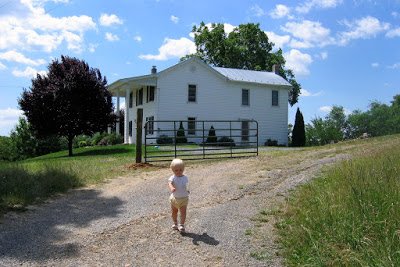
    When M leaves for work weekday mornings N and I head outside to do some of our own. Yesterday I…er, we…dug up a post, moved it to its new home, mounted the gate, and let it stand.

    It was the beginning of an attempt to keep N in and rogue cattle out:

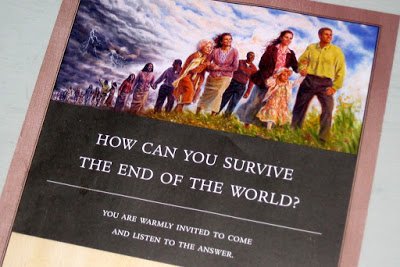
    Today I…er, we…added the post on the other side of the gate, which I guess made the formation look formidable because not two hours later a black minivan with young men wearing ties pulled up and stopped on the other side of it. One got out and walked around the gate to our side door and knocked.

    By that time, 11:30, N and I had eaten lunch and she was headed for the crib. We got off the floor where we’d been reading picture books and I carried her to the door for this and–thankfully–no more:

  • goodbadi

    Church Modeling

    Over the last few months I’ve enjoyed the services at a large, “high church” church. The professional organ pieces, the liturgy, the well-thought-out and intellectual sermons, the sunny sanctuary are, I find, relaxing and enriching.

    This Sunday morning we visited a small country church where a friend pastors. No professional organ player there, of course, and no liturgical readings, but we were greeted more warmly than most places we’ve visited and the Sunday school discussion about Jesus for President: Politics for Ordinary Radicals was a satisfying blend of politics, pragmatics, and scriptural acrobatics based on the story of Jesus facing temptation and why he didn’t lead his mob to do great social movements.

    “He should have taken over General Motors,” I said.

    From my friend’s sermon I learned that in Jesus’ day the mustard plant was a sort of weed, which makes the parable of the mustard seed multifacetedly subversive rather than–this is how I always heard it interpreted–an assertion that even the smallest act of evangelism can have far-reaching ramifications.

    The sermon was also about church growth–the four families on vacation cut the service attendance drastically–which spawned in me the thought that small churches shouldn’t try to be big churches.

    Big churches have programs and formal services down pat: Sunday school classes, nurseries, choirs, dramas, great musicians, vacation Bible school, airy buildings, you name it. I enjoy all of those things immensely.

    Small churches often think they must have those same things. This means that the small churches’ members have to fill multiple roles and perform multifarious duties that end up making church very tiring for everybody, all the while just hoping and praying that more people will come, more people to lighten the load and swell the ranks.

    I say let big churches be big churches, and let small churches do things that really reflect who they are. One small church we visited ate meals together in each others’ homes after their weekly sermon-less services of nontraditional activities including music, hands-on creativity, and discussion. The leaders of the church searched within its members to find direction and evolve rather than looked to large-scale models for growth goal setting. We likely would have attended that church more had it not felt too overrun by the college campus where it met.

    There’s a fine place for big churches, especially maybe for people like me who like Sunday morning to be an aesthetically pleasing, intellectual, quieting time to sit back and reflect. There’s also a fine place for small churches–as long as they are created not from a “keeping up with the Joneses” mentality but from their own organic roots.

  • goodbadi

    Meaningful Church

    Some people want church to be a place to meet others different from themselves; some want a distinctly spiritual connection with the people of their daily lives; some a restful place of aesthetically pleasing nourishment. As church visitors for the last nine months, M and I have grappled with what church might mean for us, and we’re still grappling.

    Today we forged up the road to the very next building, a small church (65 in attendance?) with a cross that lights up at night, a bell actually rung by hand before the service, a small playground and pavilion, and an aura of settled, old blood. The names and faces felt local; the cemetery and church interior spoke of years and years of generational worship.

    The pianist stumbled through the three hymns, all of which we knew by heart, which was good since no one provided us with a hymnal (they eagerly cleared away some piles of handouts from some back seats for us and went out of their way to give us a bulletin, so it wasn’t that they weren’t hospitable). The Bible school coordinator displayed on the LCD projector a short video teaser showing excited jungle animals like monkeys interspersed with kids enthusiastically learning the Lord’s Prayer. The pastor then showed two motherhood related video clips and gave a rousing sermon about tithing, half of which M and I each missed because N found the morning breezes and sunshine irresistible.

    Because I was in and out so much, I wasn’t sure (until M told me, later) what the sermon was about—Mother’s Day, or buying into heavenly stock.

    I noticed that the sign-up sheets, on the back bulletin board beside our seats, weren’t all filled—only January, for the children’s story; most months had greeters, except May and one or two others; the newly posted Bible school list was completely empty—and that while there were no flags in the sanctuary, at least two soldiers were listed in the bulletin prayer list, along with another man’s “prostrate.”

    Afterwards a few people greeted us. “We live right over there, and wanted to come meet our neighbors,” we told them. We asked one woman if Sunday school would be meeting and she said yes, but most people seemed to be streaming away, and so we followed suit.

    We’ve known and, yes, loved such churches, where enormous efforts to throw Bible schools and straggle through hymns and reassure the faithful are so often borne by the motivated few and the little-paid pastor. We’ve also known the intricately planned sermons, professional organ playing, and liturgical rhythms of our of-late usual church visiting haunt where we in spite of our reservations have begun to belong as much as any of the other many transplants there.

    “I’m glad we visited,” I told M as we walked home this morning.

    “Me, too,” she said.

  • goodbadi

    De-“Solely Spiritual”-izing David

    I accept whatever agnostic tendencies I find in myself by noting that Jesus’ challenging words in Matthew 25:44-46 essentially and simply equate service to, relationship with, and redemption through him to the grit and grime of everyday, person-to-person reality.

    (Actually, I’m not sure if I think of myself as having agnostic tendencies. As The Freakwenter writes, “To explain why I’m neither a believer nor an athiest nor an agnostic, consider this: God sits far beyond the power of verbal description. Then, regardless of whether God exists, God also sits far beyond the power of verbal denial, and also beyond the even-handed verbal analysis of agnosticism.”)

    While some people see “personal relationship with Christ” as being the focal point of Christianity, with all other relationships and actions crowded under that one umbrella, I suspect that, whether or not there is a heavenly, spiritual arena, it is my immediately tangible world that embodies what really matters and cries out for what little I can do and be.

    In Sunday school on a recent Sunday–we were visiting a class about marriage; the day’s topic was how to handle your spouse’s past mistakes–we read the story of David and Bathsheba and then discussed in small groups the resulting Psalm 51 in which David writes in verse 4, “Against you, you only, have I sinned and done what is evil in your sight.”

    “I think David is in denial,” I said. We were supposed to be talking about David’s handling of his past mistakes, but we’d only come up with things like “He’s remorseful” and “He wants to be pure.”

    “In denial?”

    “Yes. David did not, as he says here, sin against God only. What about Bathsheba, Uriah, his people, his nation. What about them?”

    “Oh, but he’s speaking in hyperbole or something,” one lady said so quickly that I hadn’t even inhaled yet after my daring attempt at creative scriptural interpretation. “He can’t be in denial. Those people are included in his use of ‘God.'”

    Due to the intense rejection of what I thought was a remotely plausible idea, I didn’t add that the Psalm also suggests that David took less than complete responsibility for his actions–it was his mother’s fault, after all: “Surely I was sinful at birth, sinful from the time my mother conceived me”–and that he appears to have been seeking the easiest way out, by calling down divine intervention:Cleanse me with hyssop, and I will be clean; wash me, and I will be whiter than snow.”

    Now, I can accept that exclusively God-based forgiveness is sometimes the only conceivable enabler of fresh starts. And maybe that sort of forgiveness is what David really did need, here, since Uriah was already dead and since David by then couldn’t really undo anything regarding Bathsheba. There are times of desperation.

    But while my “creative” interpretation of Psalm 51 may be a little too, shall we say, creative, I still suspect that when all that “convicted” people seek are fix-and-forget-it cure-alls, we may find ourselves shirking our own essential, painful steps towards righting past wrongs and restoring joy, person to person.

  • goodbadi

    Musical Sacrilege?

    Soon after M and I released our 2005 album, our half-hearted attempts at marketing our music took us to a small bulk foods store in a nearby small town.

    Yes, they would sell the CD for us, they said, but they wouldn’t play it over their sound system in the store because they only play “Christian” music.

    Our music, not Christian? Was that even possible, since we had always been dyed-in-the-wool Christians ourselves?

    Admittedly, none of the songs we’d recorded were of the “three chords for the Lord” flock, but they were all about life–which I’d say made them pretty much at least relevant to Christianity despite their lack of religious sentimentality.

    And besides, don’t Christian people so often deal with the exact same issues as non-Christian people? Things like greed, arrogance, and, well, shameless self promotion? No, there is nothing special about life that prohibits it from finding itself sung about under both “Christian” and “non-Christian” labels.

    Certainly one might argue that Christian musical treatment of common life might reflect a higher passion or even inject that flair into its listeners while secular music can only lead us to looking at ourselves through dimly blurred mirrors, but in reality the religious value of a song is most often only specked somewhere in the beautiful eyes of the beholders.

    For example, some people think that fiddle tunes and even classical movements aren’t “Christian.” I know others who insist that rock music instrumentation in itself is evil, in part because it, regardless of lyrical content, speeds listeners’ heart beats per minute and makes them do crazy things. Just look at the people jumping up and down when Petra sings Dance–and Petra is even one of the all-time historical Christian rock bands. Just think about how excited you get when Tommy Emmanuel plays Classical Gas and beats his microphone with his head.

    Occasionally songs from distinctively secular markets find themselves assigned Christian depth. Not too long ago we found ourselves visiting a church where the preacher recited excerpts from Neil Diamond’s Brother Love’s Traveling Salvation Show as an example of “finding a connection with others and with God.”

    “But that song,” my mother hissed to me, “is making fun of religion!”

    “It could be,” I said. “I think it is, too, but you wouldn’t have to think that. It’s a great song.”

    (We mustn’t forget that Dolly Parton sings that song, too, about Brother Love, which brings it to a whole new level of sacrilege or worship, depending.)

    Then there’s that really funny, karaoke-friendly Eight-Hundred-Pound Jesus by Sawyer Brown, which I can’t ever be too sure isn’t tongue in cheek, and Josh Turner’s Me and God, perhaps the most blasphemous song I’ve ever heard but which I suspect many religious types love. Are these songs sacred or sacrilegious?

    Sacred, secular, or otherwise, one song that in my book tops many is Paul Simon’s spiritually insightful and religious trappings-less Outrageous, which has become, as I’ve listened to it over the years, ever more meaningful for no reason in particular but partly because after hearing “Who’s going to love you when your lips are gone” I checked the album lyrics to find what Simon really sings.

    Enjoy.

  • goodbadi

    Church

    Craving a lull in our ongoing church hunt, M and I have decided to attend for the remaining few months until we move one of the three churches within comfortable walking distance of our apartment. We’ve enjoyed the sermons, the music, the friends we already know, the many people we meet if only because they adore N, the airy sanctuary, and this past Sunday’s potluck, at which I had a very large piece of fried chicken, two pieces of cake, and lots of other samplings.

    As some might perceive of me as an occasional spokesperson for antiestablishmentarianism when it comes to formalized, pious, and showy religious order, our selection of an institution that I continue to dub as our denomination’s “high church” in this town may be surprising. The pipe organ and grand piano; the broad pulpit on the broader stage; the weekly (very gray and well suited) attendance of 329; the huge parking lot; the denominational university’s current and past presidents, professors, and intellectual products; the radio broadcast studio and online sermon video production–all make for an expensive and refined religious experience.

    This excerpt from a John Updike quote noted by Garrison Keillor on this weekend’s A Prairie Home Companion fits how I feel about attending our current religious haunt:

    “Taken purely as a human recreation, what could be more delightful, more unexpected than to enter a venerable and lavishly scaled building kept warm and clean for use one or two hours a week and to sit and stand in unison and sing and recite creeds and petitions that are like paths worn smooth in the raw terrain of our hearts? To listen, or not listen, as a poorly paid but resplendently robed man strives to console us with scraps of ancient epistles and halting accounts, hopelessly compromised by words, of those intimations of divine joy that are like pain in that, their instant gone, the mind cannot remember or believe them; to witness the windows donated by departed patrons and the altar flowers arranged by withdrawn hands and the whole considered spectacle lustrous beneath its patina of inheritance; to pay, for all this, no more than we are moved to give—surely in all democracy there is nothing like it.”

    On the first Sunday that M and I walked through its surroundings of neatly kept ranch houses in tidy lawns to join the democracy attending the “venerable and lavishly scaled building,” we passed the neighborhood’s sole less appealing house, the one with busted-out windows, decrepit roof, scraggly lawn, and sorry cars parked around it.

    It was a cold morning–N was bundled and wrapped in blankets and strapped into the jogging stroller–and just as we approached this dump of a house, an upstairs window scraped open and a young, bare arm shot out, flinging the yellow liquid contents of an old metal Folgers coffee can over the lawn–and down upon the bicycle leaning against the building just below–and then wholly receding with a shuddered slam.

    “Oh my word,” I turned to M. “Did you just see that? At least that bike has a nice set of fenders.”

    This Sunday after church we again packed N into the stroller and set out through the balmy afternoon sunlight to trek home. As we approached the eyesore of a house again, I heard a creaking and clink and a “Good afternoon” as a white-haired man carrying a metal crutch against his handlebars rode past us on none other than the nicely fendered, previously doused bike.

    I recognized him and his stiff suit and tie, his yellow-white hair rigid over thick glasses, his somehow rattletrap demeanor; he’d attended the same Sunday school class as us, the one in which a renowned church scholar had presented a heady impersonation of St. Augustine.

    We watched as he slowly coasted (meandered, really) off the street, leaned the bike against a tree–thankfully not directly under any window–and hobbled on his crutch up the ailing wooden steps and into the house.

  • goodbadi

    Hymns Most Relevant

    Among the myriad of issues arising from my and subsequent generations’ addictions to television, iPods, and media in general is that many of us have become consumers, not creators. This plays out in many different ways, church sanctuaries notwithstanding. My denomination, which has traditionally thrived on four-part, a cappella hymn singing, is becoming just like any other where passionate praise bands appear to worship cool PowerPoint presentations floating up from LCD projectors.

    This change is not happening without reason. Parents who have grown up with hymn singing are worried that young people will turn away from the church because of the old music. Young people want to contribute their musical skills of piano playing, guitar strumming, drum beating, and microphone crooning to their churches. Evangelistic tendencies require reaching out to and including the unchurched and musically nontraditional.

    While none of these motivations lacks validity, four-part, a cappella hymn singing cannot be simply left behind as old fashioned, out of touch, or irrelevant. Indeed, closing hymnbooks and opening guitar cases is not as much choosing a more contemporary style as it is neglecting a key component of the true value of church.

    To a great extent, joining church is about craving and contributing to something that is greater than the sum of its parts. To hymn singing each participant brings with a unique tone, voice range, and understanding of why they sing. But when they add their voices to the musical fray, they are giving, receiving, belonging—and relying on themselves and each other without external or even technological intervention.

    This intense experience of community has not been lost on younger generations. When I was in college, friends and I borrowed hymnals from the campus auditorium and sang out our hearts in a dorm stairwell—for fun. Consistent during the same period was the marked increase in fervor and attendance at every chapel service hymn sing. Just this past weekend, my uncle told me about his middle school boys’ a cappella choir where the boys are awed by the sound that together they alone can create.

    Beyond traditional venues, I recall my year of voluntary service in an arts program for prisoners and the intense excitement sweeping through inmates when they were joined by group of really good singers recruited to shape musical rehabilitation. The inmates were incorporated into something beautiful and found themselves contributing and belonging to something seemingly otherworldly.

    I’m guessing that if rising generations and even unchurched newcomers are taught to sing four-part, a cappella hymns, many of them will—and quite eagerly at that. They will be inspired by both old and new songs and new ways of singing old songs that reflect our continually evolving theology, ever-broadening community of believers, and increasingly pragmatic hopes.

    We’ll need hymnals—and every last person’s voice.