• goodbadi

    Advent 2013 Drama 1: The Conception of John the Baptist

    Exploited
    from Luke 1:5-25 (
    The Message)


    CHARACTERS:
    Zachariah, aged, wearing an everyday shirt
    Elizabeth, aged, wearing a covering
    Angel Gabriel, carrying rolled up scroll
    Crowdmember 1
    Crowdmember 2
    Crowdmember 3

    SCENES:
    Home with two seats
    Temple inside, with incense
    Temple outside

    SCENE 1 (Elizabeth and Zechariah sitting at home):

    Zachariah: I’m an old man, Lizzie.

    Elizabeth: Oh, but you’re a good man.

    Zachariah: That’s what God thinks, too. Not to brag or anything.

    Elizabeth: And I’m an old woman, Zachy, sagging and bagging all over the place.

    Zachariah: Oh, but honey, you’re a good woman, sags and all.

    Elizabeth: That’s what God thinks, too. Not to brag or anything.

    Zachariah: But God’s always right, you know.

    Elizabeth: Yep. As the saying goes, “The Bible says it. I believe it. That does it.”

    Zachariah: Except we’ve not been truly tested–err, I mean blessed.

    Elizabeth: Right. (Sighing) No kids.

    Zachariah: Bummer. It’s all your fault, of course.

    Elizabeth: I know. It say so in the Bible.

    Zachariah: It does? Oh rats and mouse traps! I’m late for temple duty again. I’d better run. Where are my camel keys?

    Elizabeth: Don’t you want to put on a clean shirt?

    Zachariah: Nah. I’ll be burning incense. It’ll cover up a multitude of sins.

    SCENE 2 (In temple, crowds without):

    Zachariah burns incense.


    Gabriel appears. Zachariah, startled, slowly kneels onto his aging knees.

    Zachariah: Oh, my knees. Why do I have to do this “fear the angel” thing every single December?

    Gabriel: Don’t be afraid, dad.

    Zachariah: Dad?

    Gabriel: Yup. For your prayers have been heard and your wife Ellie–

    Zachariah: You mean Elizabeth

    Angel: Right. Your wife Elizabeth will bear you a daughter–

    Zachariah: A daughter?

    Gabriel: Drat. Where’s my scroll? Let me just read this: Do not be afraid, Zechariah, for your prayer has been heard. Your wife Elizabeth will bear you a son, and you will name him John. You will have joy and gladness, and many will rejoice at his birth, for he will be great in the sight of the Lord. He must never drink wine or strong drink; even before his birth he will be filled with the Holy Spirit. He will turn many of the people of Israel to the Lord their God. With the spirit and power of Elijah he will go before him, to turn the hearts of parents to their children, and the disobedient to the wisdom of the righteous, to make ready a people prepared for the Lord.

    Zachariah: Not to be a doubter, Angel, but I’m a bit skeptical. Rather dumbfounded, exactly. You see, I’m, uh, rather old, and my wife makes Methuselah look like a spring chicken. I mean, Lizzie’s so old her dentures have dentures.

    Gabriel (angry, pulling self up to full height): I am Gabriel. I stand in the presence of God, and I have been sent to speak to you and to bring you this good news. But now, because you did not believe my words, which will be fulfilled in their time, you will become mute, unable to speak, until the day these things occur.

    SCENE 3 (Outside of the temple):

    Crowdmember 1: Where is he? What’s taking him so long?

    Crowdmember 2: Does burning incense release carbon monoxide?

    Crowdmember 3: Or was he burning the incense that shipped in special from San Francisco?

    Zachariah emerges, motioning with hands.

    Crowdmember 1: Oh look! Charades!

    Crowdmember 2: Chicken!

    Crowdmember 1: Turkey!

    Crowdmember 3: Some kind of bird…

    Zachariah (grabs a tablet and writes): I’m apparently not the only dumb one here.

    Crowdmember 1: Angel!

    SCENE 4 (Elizabeth at home; Zechariah arrives):

    Zachariah (writing excitedly): You’re pregnant. Or going to be.

    Elizabeth: What?

    Zachariah: (waves arms)

    Elizabeth (loudly): WHAT? Have you been burning that California incense?

    Zachariah (writing): Baby, Lizzie-baby! Baby!

    Elizabeth: I’m almost pregnant? Yippee!

    Crowdmember 1: Curtain! Curtain! Somebody quick pull the curtain!
  • goodbadi

    A Rash Exposure

    Several adults with disabilities attend our church along with the rest of us who have our own sorts of disabilities, probably more than we would think about without the more obvious reminders provided by our officially diagnosed fellow bench warmers.

    Take, for example, J, who actually isn’t brought along anymore because he was too frightening to some others. J would stand up during sharing time and reach for the roving mic and then preach a fiery sermon, pounding or slamming down his Bible in his drawn-out passion. Occasionally the rest of us could catch a few words (“heaven,” “Mom,” “tree”) but mostly it was entirely nonsensical for us listeners, and our pastor would eventually intervene and move the microphone along to the next person, who as “non-disabled” spoke in clear, complete sentences–perhaps about God’s will and definite-if-undisclosed purposes–that, frankly, made little more sense to me than had J.

    My response to so much of sharing-time God talk–and most other God talk–is, “What does that mean?” Or, “What does that mean?”

    Now, I recognize that people need some sort of big-picture order to the cosmos, as do I. I just don’t often get theirs.

    My preferred suggestion of the order is this: Good/God/Love enriches life, and Bad/Evil/Hate ruins life. In the fog of reality, what is what can be confusing; the devil is in the details, which require a lot of grace, and so we do what we can. I may be as qualified as anyone else to discount buddy-God religion or atheism or anything, but I like to think that my “ordering” is humble, flexible, and nonexclusive yet true to my own feeling that there is, whether I believe it or not, some sort of higher reality.

    Sometimes “spirituality” strikes me as a bit, well, mostly about control, getting out the God lobby to pray some sense into the big Dude in the sky who is driving it all but apparently needs steering advice.

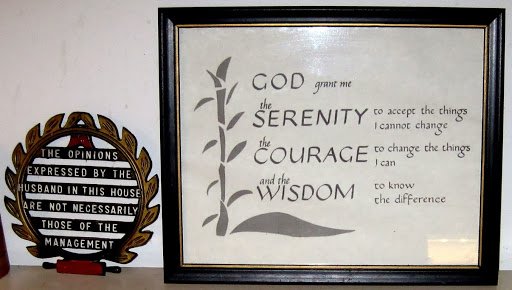
    It makes sense, of course: since we can’t physically do anything about most everything, we pray to God–humanity’s last hope–for help so things will turn out okay. While I’ve certainly prayed that way before, I see prayer and spirituality more as being quiet meditativeness for calming my mind and sorting through the fog. Think the serenity prayer.

    By the way, M has posted that prayer in our kitchen. A friend recently pointed out its entirely unintentional on our part, but completely appropriate placement right next to the little trivet my mom found for my bachelor’s pad before M and I had even started dating:

    Another person at our church, A, who is my age and likes bugs and plastic bling, gave her own unwitting commentary on prayer last Sunday, inadvertently exposing the me-centeredness of common prayer.

    Our procedure during sharing time was for someone nearby the person who shared a burden to pray for that person. A eagerly offered to pray about another congregant’s rash: “I hope you feel better, R.” Then, without even a split-second pause for breath, she shifted gears and continued praying: “My legs have been hurting me, and I have to go back for more appointments” and so on.

    Perfect.

  • goodbadi

    Bulletin Cover

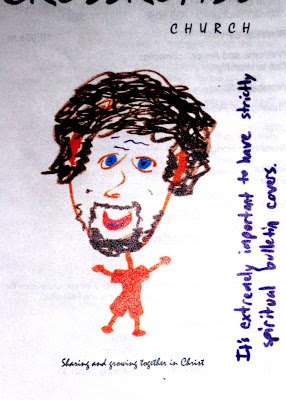
    An annual church retreat tradition of ours is to make artistic bulletin covers, which are then photocopied for a Sunday morning service. One of my designs from retreat earlier this month was used this past Sunday:

  • goodbadi

    Les Miserables: A Film of Grace

    The powerful film Les Miserables is not only wrenching in its portrayal of human squalor and immensely hopeful; it also is an expansive summary of the meaning of Christianity.

    The premise of the story is simple: a man shown grace lives a life of showing grace, while another man shown grace rejects it and in its face self destructs. That grace shown cuts each man to his core and causes an agony answerable only by reinvention. The inspiring protagonist works out his redeeming salvation by exercising that grace; the other man refuses to accept or show grace, sticks to rightful insistence, and can face living no more.

    Love versus law, giving dignity to the ashamed versus meting out just desserts, persistent hope versus historical grievance: the cinematic dichotomies are the material of a New Testament treatise, without the baggage of conditional theology. Les Miserables is but a story about people accepting (or not) the only possible enduring response to our human fallibility: grace.

    To accept that grace is to receive welcome permission to live graciously; to reject that grace advances one’s own meaningless destruction.

  • goodbadi

    A Christmas Hope

    Earlier this week NPR’s morning news report moved seamlessly from the Connecticut school shooting to something like “the names of ten nine- to eleven-year-olds are still unknown”; after a moment of confusion I realized the story had changed to a bomb blast in Afghanistan.

    Additional news compounds the season’s weightiness stateside: Calls for increased gun control measures encourage assault weapons purchases; the Westboro Baptist idiots talk about picketing the Sandy Hook Elementary School victims’ funerals.

    It’s a heavy time for me as a parent and teacher–and I can’t even begin to imagine the grief now faced by families and the communities in Newtown or east of Kabul.

    And it’s Christmas, when we sing about the Prince of Peace’s reign on Earth and proclaim that justice “shall guard his throne above, and peace abound below,” all of which “no end shall know,” lines from one of the five or so hymns I ever learned to play on the piano, the yuletidal To us a child of hope is born.

    I believe in what that song is about, but not because God is my security chief. (If he were, I’d better get my head out of the sand real quick and start looking at other options; as far as I can tell, God isn’t doing a very good job of protecting the innocent.) Rather, I believe less in God personified or deified and more in Earth-grounded goodness that is life giving; the Christ child symbolizes hope for a better way of life that, while upside-down, cultivates that which is right.

    It’s a messy theology, with few clear-cut answers and lots of human obligation; my Christmas hope cannot be removed from humanity’s roles as justice guarders and peace abounders.

    Yet hope I do: that even in the inevitability of our vulnerability to nature, each other, and ourselves, all that is life giving will increase and know no end.

  • goodbadi

    A Spirituality of Shutting Up

    A radio interview I heard last week about spirituality seemed nothing more than an Evangelical Buddhist moment: Quoted statistics demonstrated nothing, anecdotes related nothing, and questions about insights resulted in no answers. I was left to work out my own sort of meaningful answer to the topic of the day.


    And so here it is, unprofound and short though it well may be: To be spiritual is to listen. 


    Reading counts, certainly, at least if it’s of thoughtful content, as may being quiet and looking at nature and watching people and doing many other things, too, like listening. 


    Journaling may count, too, since putting thoughts into a notebook allows you to listen to yourself, but blogging for an audience really doesn’t, as it mandates outbursts of humor and irony that (as I learned in another less-than-satisfactory interview…sorry, it must’ve been a bad week at NPR) undermine sincerity and the very fabric of relationship in our society. It’s too noisy.


    (Even N gets irony: As we drove down the road yesterday she bemoaned the fact that we hadn’t said goodbye to our dear dog. “You’re right,” I said, quietly adding, “Bye, Canela”–at which N gave her I-get-it “Ha-Ha.”)


    There are many Biblical examples of silence and listening as spirituality: Jesus went off by himself quite a few times, apparently; Jonah had a (probably ranting- then listening-filled) run-in with the gastric elements of a godly super fish; and Jesus when questioned by Pilate wouldn’t say anything (even though Pilate did seem ready to listen, at the moment…I’m not sure which of the two guys was being more spiritual, just then).


    And then, since it’s Advent, a time of expectation and hopefully listening for new spiritualesque adventions, there was Zechariah, surrounded by idiots who didn’t seem to realize that he was dumb, not deaf (“Then they made signs to his father, to find out what he would like to name the child.” That’s ironic, right?), after he disbelieved God’s right-hand bad-boy Gabriel’s letting him know that Zechariah’s dear wife of many years and he would conceive someone relevant to the world. He’d gotten a bit testy and hadn’t replied to the message with a simple “Yessir,” so good old Gabe saw fit to mandate a bit of shut-mouth for the big Z.


    There are lots more examples, I’m sure. Like the time Loretta Lynn was working in her garden in Coal Miner’s Daughter and told her own daughter something like, “Hush, now, darling, Mommy’s working on a song,” which sort of happened to me except that I was rototilling and wearing ear plugs while working on a song, and I didn’t call myself “Mommy,” and no one was trying to interrupt me, and so really it wasn’t that difficult to listen to the artistic little voice inside me. 


    And there’s always the listening-based spiritual discipline of reading Joel Stein in Time and vacillating between wrinkling my brow, blushing, and nodding enthusiastically. That last part happened to me once, at least, when he wrote rather funnily about our society’s too-much reliance on humor, which is, by the way, I think, the essence of what the anti-irony lady on NPR back in my fourth paragraph was saying.


    (Speaking again of irony, Time had a great “don’t worry about the death of irony” factoid: Romney’s share of the popular vote was around 47%.)

    Just in case you’re tired of listening to others’ rampages and causes and concerns–that might mean you’re not into spirituality, yet, although I’m sure you’ll grow into it eventually, if Gabriel has anything to say about it–maybe you can sign up with this guy. I’m going to show the flick to my students tomorrow, to remind them what irony is.

    (I’d thought about showing them this whole post with its irony, for fun, but for public school it’s probably way too spiritual.)

  • goodbadi

    Acts 8:26-40

    CHARACTERS:
    God’s Angel, always flapping his wings
    Philip, talking on his cell phone
    Ethiopian official reading in a chariot riding along the road
    A pond, standing beside the road, with a cup of water


    GOD’S ANGEL, flapping his wings: Hey Phil!


    PHILIP scared: Ahhh! What do you want?! (Into his cell phone) Honey, I’ve got to go…something’s come up.


    GOD’S ANGEL, flapping his wingsAt noon today, walk over to that one road going from Jerusalem to Gaza. Don’t wear your ear buds, and turn off that infernal cell phone, too.


    PHILIP scared: Ahhh! Okay! I’m going!


    Along the road, he meets the Ethiopian official, reading aloud from Isaiah.


    OFFICIAL:  As a sheep led to slaughter,
          and quiet as a lamb being sheared,
       He was silent, saying nothing.
          He was mocked and put down, never got a fair trial.
       But who now can count his kin
          since he’s been taken from the earth?

    GOD’S ANGEL, flapping his wings: Jump in that rig there, now!


    PHILIP: What? No way. I’m not chariot jacker!


    PHILIP runs along the official’s chariot.


    OFFICIAL: Ahh! Awkward! Awkward! Door locks! Doesn’t this thing have any door locks! Police! Police!


    PHILIP: Chill, dude. I just want to know what you’re reading. Do you understand it?


    OFFICIAL: Uh, no. I have no one to explain it to me, so of course I’m clueless. Here, help me out.


    PHILIP: Well….okay.


    OFFICIAL: Tell me, who is the prophet talking about: himself or some other?


    PHILIP: It’s about Martin Luther King, Jr.


    GOD’S ANGEL, flapping his wings: What! Hold on, Phil–MLK had kids, and he talked a lot!


    OFFICIAL: Who?


    PHILIP: I mean, uh, Jesus! It’s about Jesus! The guy who said to be poor, and to share, and to be meek and humble and generous, and to waste perfume.


    OFFICIAL: Hey, look–water! Why can’t I be baptized? 


    PHILIP: You can! You can!


    OFFICIAL: Stop the chariot! Stop the chariot!


    Philip grabs the cup of water from the pond and pours it over them both.


    God’s angel, flapping his wings, grabs Philip and takes him away. 


    OFFICIAL: Huh. Curious. But now I’m alone. I’M ALL ALONE! I don’t mind, though. I’m really happy! Yippee! (Continues down the road.)


    PHILIP, finding himself in Azotus: Wh…wh…what was that about?


    GOD’S ANGEL, flapping his wings: Go to Caesarea, Phil, and keep on preaching.


    PHILIP: Don’t you think that was a bit…abrupt? Where am I? 


    GOD’S ANGEL, flapping his wingsThe city of Ahh’s–Azotus! 


    PHILIP: What? You’re kidding me! This is ridiculous. Oh well. (Sees a nameless passerby.) Hey, you! Have you been reading any good books lately?

  • goodbadi

    A New Salvation

    The story of Zacchaeus provides a view of salvation that is different than the atonement theology that describes Jesus’ death as paying the ransom for the souls of sinful humanity. Instead, the story commands significant life change.

    Prerequisite to anything Jesus, at least in this story, is curiosity. If Zacchaeus’ wealth could have bought an audience with Jesus, I’m guessing Zacchaeus wouldn’t have stooped to the indignity of running ahead of the crowd and climbing a tree, just to see better. As it was, though, there he was, hanging on a branch when Jesus made his day by calling him by name down from his perch.

    That’s when other people started complaining, saying that Jesus was–oh horrors!–staying at the home of a wicked man, this tax collector who had become wealthy presumably by crooked dealings. Almost as if in response to the grumbling, almost as if he perceived that associating with Jesus required some justification on his part, almost as if he all of a sudden wanted really badly to be worthy of Christianity, Zacchaeus declared that he would not only right past wrongs but also begin to deal generously with others.

    Jesus gave his blessing to this distrusted but newly changed man by declaring, “Today salvation has come to this house.”

    Salvation? With no crucifixion? It’s the rest of the story that I find challenging and even intimidating, because if the process of salvation involves changing toward generous living, I know I am far from saved.

    Zacchaeus’ rebirth relies on no prescribed, simple sinners’ prayer, no recitation of a newly adopted creed, and no membership in an exclusive sect. The story doesn’t even say Jesus told him to do anything at all. Instead, it seems that Zacchaeus all at once both desired and knew how to bring salvation to his life.

    I suspect that every one of us has a need for the salvation of this sort, for continued turning from selfish to generous living. I know I do. 


    I have been the recipient of much generosity in the last year. In a way, many people–like Jesus in the story of Zacchaeus–have come to my house for dinner. D loaned me tools and even put in hours helping with my kitchen project. G, whom I’d previously met only briefly, not only advised me by the phone and sold me professional-grade flooring supplies; he also came to my house twice to actually do (for free!) several steps of the flooring project. M extended love and acceptance even when I was less than easy to like. A cousin–just out of the blue–offered words of affirmation even when I felt self doubt about our music. 

    And some, perhaps without even meaning to, pointed me toward new salvation. When I returned the tractor I’d borrowed to mow our meadow, our friend’s dad, who had seemed genuinely eager for me to use his little Ford, sat a while on his porch in the hot midday and talked, in part about a man he knew when growing up: “He always made me feel better about myself,” he said, “and that’s a big deal for a young boy.” 

    That was and still is a call–to this husband, dad, son, brother, teacher, uncle, neighbor–to generous living: the perspective has looked me up and invited me to a more complete salvation based on the building up of those around me. 

    And all I did was climb up onto the seat of an old tractor.

  • goodbadi

    A Telling of John 21:1-14

    (All disciples sit around a campfire, looking bored.) 

    SIMON PETER (standing): I’m going fishing.

    (Nobody responds.) 

     SIMON PETER (clearing his throat): Like I said, I’m going fishing.

     (All others look at each other, grumble and shrug.) 

     JOHN: Well, I believe we will all come along.

    (All get in the boat, shove off shore, and sit, bored, catching nothing all night.) 

    THOMAS: I can’t believe you wanted to go fishing, Rock. What a dumb idea.

    JAMES: Oh, I don’t know. I can’t say I mind the quiet time to meditate on the recent turns of events that have really thrown us all for a loop. As Buddha would have said, “When things go wrong, there’s nothing a little fishing won’t fix.”

     JOHN: I don’t believe Buddha ever said that. 

    JAMES: Stop interrupting my being-less-ness, please.

    NATHANAEL (yawning): Fishing sure beats working on my kitchen, though. Not that I know how to work on it, since I have no carpentry skills. Let alone money. Should I just scrape by so I can pay someone to do it all? Limp through just trying to do it myself? Settle for whatever? Whatever. Kitchens!

    THOMAS: Fishing also sure beats hiding out behind locked doors. In fact, this is much better. Here we are, just sitting out here in the open, nothing to shield us from the ridicule of everyone pointing at us and laughing: ‘Hey look! All the king’s men!’ … ‘Fishers of men! Ha! They ain’t even fishers!’

    SIMON PETER: Okay, okay, so I can’t deny that we’ve caught no fish tonight. But you all shush; I think that turkey on the beach is listening to every word we say. Or else he’s studying my studly chest, since I’m not wearing any clothes. It even says it in the Bible: I’M NOT WEARING ANY CLOTHES!

    (Jesus stands on the beach.) 

    JESUS (calling): Good morning! Did you catch anything for breakfast?

    THOMAS (calling): No, and–I believe my grumbling stomach–not for a midnight snack, neither.

    JAMES (calling): It’s okay, though–we’re just loving the meditating that we’re getting done. 

    NATHANAEL: Shut your traps, boys, or I’ll put you all back in my new root cellar and put a trash can over the trap door. (Calling) No.

    JESUS (calling): Throw the net off the right side of the boat and see what happens.

    SIMON PETER: I think I’ve heard that before.

    JOHN: Just do it, guys. You know, believe.

    (They throw the net off the right side, and it nearly pulls them into the water.) 

    JOHN: It’s the Master! James, where’s my notepad: This is perfect for my book!

    SIMON PETER: Holy Smokes! (Pulls on some clothes and jumps into the water.)

    (Disciples pull the net to shore, where a campfire is laid out, with bread and fish.)

    JESUS: Bring some of the fish you’ve just caught.

    NATHANAEL: Just a sec. We’ve got to count these, first.

    (The disciples count the fish while JESUS impatiently taps his foot.)

    JAMES: Oohmmmmmmmm…153 !

    THOMAS: Can’t be. Net’s only rated to 75. 

    SIMON PETER: Thomas, we know how to count.

    NATHANAEL: Fellows, I’ve got it: I’m going to turn these 153 fish (minus a few for breakfast, of course) into that new breakfast nook in the new kitchen.

    JESUS: Breakfast is ready.

    (JESUS serves them food.)

    SIMON PETER: Yum. I love fish for breakfast. I could eat this every day.

    THOMAS: You already do.

    JAMES: Buddha loved fish, too.

    JOHN: Right.

    NATHANAEL (thinking to himself, aloud): I’m not going to ask if that guy’s Jesus. (To the others) Anyone know of a good fishmonger? I’ve got a feeling my boat’s just floated straight into my kitchen.

    THOMAS: Enough already about the kitchen, Nathanael. (To himself) I’m not going to ask if that guy’s Jesus.

    JOHN (to himself): This is the third time, right? Man, if this won’t make people believe. (To the others) My boat’s a book, and I’m with Nathanael, here: the paddle’s in my hand already.

  • goodbadi

    Personal Day of Irony

    As yesterday was the National Day of Prayer if you were at the moment a U.S. citizen and the National Day of Reason if you were a Humanist, NPR reported that at least some Humanists were celebrating by doing good deeds like giving blood, thereby essentially turning themselves Christian.

    Later in the day I rose to an occasion in a way I’ve long longed to do: Usually when a telemarketer calls, I annoyedly say something like, “No thank you, I’m not interested,” and hang up; before yesterday I had never successfully emulated the model of discourse I heard presented years ago by one of my church denomination’s stewardship gurus, who said that he tells such callers, “I’m already happy, and I don’t think your such-and-such will make me any happier.”
    As I was working last evening, I for the umpteenth time received a call from John of Home Protection offering me a free burglar alarm system if I would just place their sign in their yard (and pay a monthly service fee, I’m sure). 
    “Well,” I said. “Thanks for calling, but I feel pretty safe here at my house, and I don’t know that I have anything anyone would want to steal anyway, so I don’t think I need that.”
    “Alright, thank you,” he said hanging up.
    I went back to my task–putting locks* on our doors.

    *So maybe they were just screen door hook-and-eye latches to prevent H from heading out on her own, but if I don’t say that part, it’s a better story.